French exit tax and relocation to Dubai: applicable regime and key points
Interaction between article 167 bis CGI, the France-UAE tax treaty of 19 July 1989, the UAE Corporate Tax, and Cabinet Decision 85/2022. Deferral upon election, guarantees, fiscal representative, and a worked example for a selling founder.
Why the France-to-UAE corridor is a special case
The French exit tax (article 167 bis of the CGI) applies to the transfer of tax domicile to any foreign State, including the United Arab Emirates. However, the deferral regime that applies differs substantially depending on whether the taxpayer relocates to an EU Member State or to a third country such as the UAE. Three structural elements drive the analysis:
- The France-UAE tax treaty of 19 July 1989, amended by protocol on 6 December 1993 and supplemented by the OECD's BEPS multilateral instrument.
- The non-NCST status of the UAE within the meaning of article 238-0 A of the CGI: the Emirates do not appear on the French list of non-cooperative States and territories — a point that notably conditions the treatment of gifts and relief during the deferral (burden of proving the absence of a principally tax-driven purpose, Article 167 bis, VII of the CGI). The deferral upon election under article 167 bis V CGI remains available in any event.
- The absence of the dual condition required by paragraph IV of article 167 bis CGI (administrative assistance treaty and mutual collection assistance treaty): the automatic deferral under paragraph IV cannot, therefore, be invoked for a departure to the UAE.
The applicable deferral regime: deferral upon election (paragraph V)
For a departure to Dubai, the deferral set forth in paragraph V of article 167 bis CGI must be requested. It is subject to:
- The filing of a guarantee proposal no later than 90 days before the transfer of tax domicile outside France (Decree No. 2019-868 of 21 August 2019).
- The appointment of a fiscal representative in France, who will remain the point of contact with the French tax authorities throughout the deferral period.
- Compliance with the reporting obligations on Form 2074-ETD then forms 2074-ETS (with, since 2019, an exemption from annual filing where the deferral covers only unrealised gains — Articles 41 tervicies to 41 tervicies L of Annex III to the CGI).
Many UAE-bound expatriates believe that no formalities are required before their departure. The 90-day window is a procedural deadline, not an aspirational target: failure to meet it results in loss of the deferral and immediate payability of the tax as of the transfer date.
Interaction with the UAE Corporate Tax
Since 1 June 2023, the United Arab Emirates has levied a federal corporate income tax (Federal Decree-Law No. 47 of 2022) at the standard rate of 9% on taxable income above AED 375,000. Entities located in a free zone may benefit from the QFZP regime (Qualifying Free Zone Person) at 0% on their qualifying income, subject to the conditions set forth in Cabinet Decision No. 100 of 2023 and Ministerial Decision No. 229 of 2025.
For the individual taxpayer placed under deferral, the UAE Corporate Tax has no direct impact on the French exit tax: these are two taxes levied on two different taxpayers (the individual for the exit tax, the company for the Corporate Tax). The interaction is instead relevant at the level of distributions received by the individual, which — for a UAE tax resident — are governed by the source-State rules under the bilateral treaty.
Documenting UAE tax residence
Securing the deferral requires, over time, the ability to document UAE tax residence unambiguously. Three alternative criteria are set forth in Cabinet Decision No. 85 of 2022:
- Physical presence of at least 183 days over 12 consecutive months;
- Presence of at least 90 days with qualifying ties (resident visa, housing, employment, or business activity);
- Permanent home or center of economic interests in the UAE.
The Tax Residency Certificate (TRC) issued by the Federal Tax Authority is a useful piece of evidence, but it is not in every case binding on the French tax authorities: on the French side, tax residence is assessed under article 4 B of the CGI and, where applicable, under the tie-breaker clause of the 1989 treaty.
Worked example
Founder-CEO of a French SAS, age 47, married without children. Holds 100% of a company valued at €5,000,000 on the eve of departure, against a cumulative acquisition price of €100,000. Unrealized capital gain: €4,900,000. No allowance applicable (securities acquired after 1 January 2018).
Calculation of the gross tax without deferral: €4,900,000 × 31.4% (PFU 12.8% + social levies 18.6%) = €1,538,600 payable on the transfer date.
With deferral upon election under paragraph V: no immediate payment. Guarantees to be proposed 90 days before departure; fiscal representative to be appointed. If the securities are held for 5 years (portfolio > €2.57M), the exit tax is subject to automatic relief (Article 167 bis, VII of the CGI — in practice via follow-up Form 2074-ETS3), strictly on the condition that no forfeiture event has occurred in the interim.
Errors specific to the UAE corridor
- Maintaining a home in France (second residence used regularly, spouse or children remaining on French territory): major risk of recharacterization of tax residence by the French tax authorities.
- Underestimating the formalities of paragraph V: poorly calibrated bank guarantee, insufficient security, late appointment of the fiscal representative.
- Conflating UAE Corporate Tax and exit tax: these are two taxes levied on two different legal or natural persons, with no direct interaction.
- Unnotified partial sale: any disposal during the deferral triggers proportional forfeiture; the tax authorities must be informed.
Operational summary
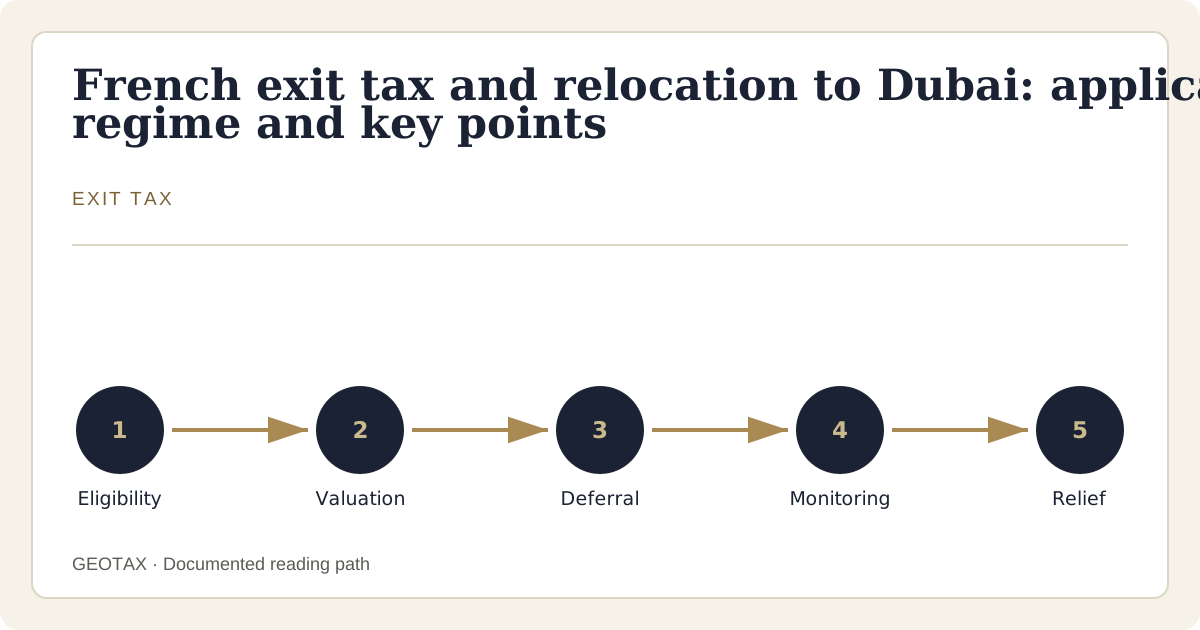
A departure to Dubai combines two complex regimes: the paragraph V on-election deferral and the post-2023 UAE tax regime. The sequence includes an audit at T-12 months, preparation at T-6, formalisation at T-3, execution at T-0, and reporting over the 2- or 5-year period: annually where the type of gain requires it and upon relevant events in the other cases.
Personalized Exit Tax audit
A one-hour videoconference to review your situation, calibrate your exit tax exposure, and secure your relocation to Dubai. Fee: AED 2,000 (approx. USD 545).
Book an auditSources & case law
References current as at the date of last revision, cited for information only. Any application to a particular situation requires an individualised analysis.
Legislation
- Article 167 bis CGI (exit tax, transfers since 3 March 2011); Article 238-0 A CGI (non-cooperative States list); Article 41 tervicies E of Annex III to the CGI.
- Décret n° 2019-868 of 21 August 2019 (on-election deferral, proposal of guarantees).
Administrative doctrine (BOFiP)
- BOI-RPPM-PVBMI-50 (exit tax); -50-10-30 (deferral); -50-10-40 (relief); -50-10-50 (reporting obligations, Forms 2074-ETD / 2074-ETS). (historical archived guidance; cross-check against the CGI, implementing rules and current 2026 forms/notices)
Case law
- CE, 9th–10th Ch., 15 December 2025, No. 495783 — the deferral suspends the limitation period for recovery; a reporting failure restores immediate enforceability only after an unanswered formal notice to regularise.
- CE, 5 February 2025, No. 476399 — limits on the retroactivity of the exit tax under EU law.
- ECJ, 11 March 2004, de Lasteyrie du Saillant, C-9/02; CE, 10 November 2004, No. 211341; CE, 29 April 2013, No. 357576; CE, 20 May 2022, No. 449038.
Key points
Interaction between article 167 bis CGI, the France-UAE tax treaty of 19 July 1989, the UAE Corporate Tax, and Cabinet Decision 85/2022. Deferral upon election, guarantees, fiscal representative, and a worked example for a selling founder.
Page references: 167 bis CGI · Décret n° 2019-868 of 21 August 2019