Exit Tax: Planning Your Departure from France
French exit tax should be described as a targeted regime affecting certain unrealised gains on shares, securities and similar rights, together with certain earn-out claims and, where relevant, certain deferred gains. It should not be presented as a general departure tax on private assets as a whole. The tax liability arising from unrealised gains, earn-out claims and, where relevant, deferred gains is determined by reference to the tax rules applicable to the gains concerned at the date of the transfer of tax residence out of France. The effective tax burden depends on the exact nature of the gains, the taxpayer's situation and the rules in force at the time of transfer. An individualised analysis is therefore essential.
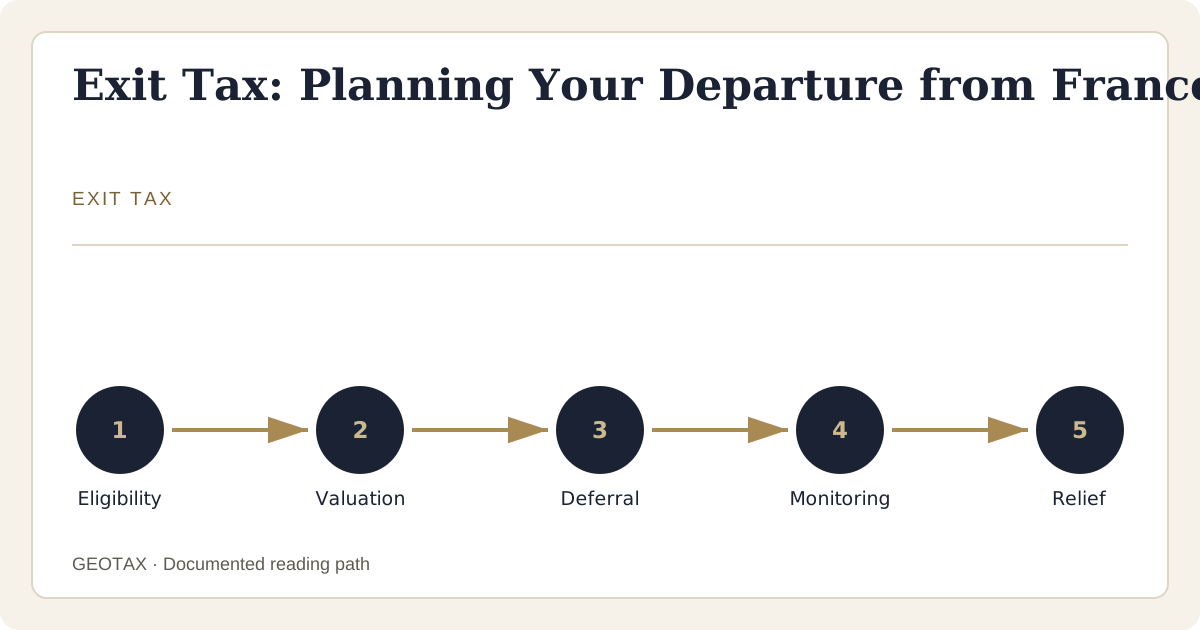
The French exit tax (Article 167 bis CGI) applies to certain unrealised gains on securities and corporate rights when French tax residence is transferred abroad. The applicable deferral depends on the destination. As at 28 August 2026, a transfer to the UAE falls under the on-election deferral in paragraph V: the France–UAE treaty does not provide the mutual recovery assistance required by paragraph IV, while the UAE is not on the French ETNC list. Relief generally follows a 2- or 5-year holding period; the exact EUR 2.57M boundary must be confirmed because the CGI and the 2026 Form 2074-ETS3 use different formulations.
The Exit Tax Mechanism (Article 167 bis of the French Income Tax Code)
Exit tax is a French mechanism for taxation of latent capital gains upon departure from France. It rests on a legal fiction: the taxpayer is deemed to have sold his assets on the eve of his actual departure, at market prices of the day, even if he does not actually sell them.
Rate and Tax Base
The tax liability arising from unrealised gains, earn-out claims and, where relevant, deferred gains is determined by reference to the tax rules applicable to the gains concerned at the date of the transfer of tax residence out of France. The effective tax burden depends on the exact nature of the gains, the taxpayer's situation and the rules in force at the time of transfer. An individualised analysis is therefore essential.
In practice, for a transfer occurring in 2026, unrealised gains and earn-out claims are in principle subject to the flat income tax rate of 12.8% (Article 200 A, 1 of the French Tax Code (CGI)), unless the global election for the progressive scale is made, plus social levies at the aggregate rate of 18.6% in force at the date of transfer (French Social Security Financing Act for 2026, Law no. 2025-1403 of 30 December 2025, art. 12) — i.e. 31.4% in total. Gains in tax deferral under Article 150-0 B ter of the CGI remain, by exception, subject to their "historical" rate (Article 200 A, 2 ter of the CGI). These rates serve as reference points: each taxpayer's actual burden must be calculated through comprehensive legal and tax analysis.
Deemed Disposition and Calculation
The calculation proceeds as follows:
- Identification of assets within scope: The scope of Article 167 bis CGI is targeted and limited to specific categories of assets — principally shares and corporate rights (droits sociaux), other securities of the same nature, earn-out claims (créances de complément de prix) and, where relevant, certain deferred gains. Real property held directly by the taxpayer, intellectual property rights held personally and crypto-assets are not part of this targeted scope.
- Fair market value at departure date: Estimated sale value by experts, stock market prices (if quoted securities), or tax assessments.
- Cost basis: Actual acquisition cost or estimated value if historical records are unavailable.
- Latent capital gain: Difference between fair market value and cost basis.
- Tax liability: Determined by reference to the tax rules applicable to the gains concerned, accounting for the taxpayer's residence status, nature of assets, and rules in force at date of transfer.
The deemed disposition is valued at the day of your actual departure from France (last day of French tax residence).
Scope of Application — Who Is Affected?
Exit tax does not apply to all taxpayers or all assets. Its scope of application rests on strict thresholds and conditions.
Conditions for Applicability
- French Tax Residency: Be a French tax resident within the meaning of Article 4 B of the French Income Tax Code (CGI) (household, principal place of stay, professional activity or centre of economic interests).
- Transfer of Residency: Permanently leave French tax residency for a foreign jurisdiction.
- Prior Residence Duration: Have been a French tax resident for at least 6 of the 10 years preceding the transfer (Article 167 bis, I-1 of the CGI) — assessed continuously or discontinuously; this condition does not apply to gains already in tax deferral.
- Participation or Value Threshold: For unrealised gains, either a direct or indirect participation, with the members of the tax household, of at least 50% in the corporate profits of a company, or an aggregate value of the securities exceeding EUR 800,000 (Article 167 bis, I-1 of the CGI).
If any one of these conditions is not satisfied (e.g., resident for fewer than 6 years out of 10, or participation under 50% and value under EUR 800k), exit tax does not apply.
Taxable Base
Exit tax applies to unrealized capital gains on the following assets at departure (per Article 167 bis of the French Income Tax Code):
- Corporate Rights and Securities: Shares, partnership interests, shares in real estate companies subject to corporate tax (SCI à l'IS), if participation is at least 50% OR aggregate value exceeds EUR 800,000. Shares in predominantly real-estate companies taxed under the individual income tax regime (SCI à l'IR in particular) are excluded (Article 150 UB of the CGI).
- Securities and Financial Assets: Quoted securities (valued at the last known price or the average of the last thirty prices preceding the transfer) and unquoted securities (fair market value), in accordance with Article 167 bis, I-2 of the CGI.
- Earn-out Receivables (Créances de Complément de Prix): Taxable on their real value at the date of transfer (Article 167 bis, I-1 bis of the CGI), subject to the same 6-out-of-10-years residence condition.
- Certain Deferred Capital Gains: Specific provisions per holding regime.
Explicit Exclusions (per Article 167 bis of the French Income Tax Code):
- Direct Real Property: Real property held personally is NOT within the scope of exit tax (primary residence, secondary residence, rental properties).
- Cryptocurrency Assets: Cryptocurrency and tokens are NOT a distinct category within the scope of exit tax application under Article 167 bis (subject to different tax regime per asset classification).
- Operating Loss Carryforwards: Operating deficits and loss carryforwards are NOT subject to exit tax.
- Professional Assets: Certain professional assets benefit from exemptions subject to conditions (SME/Mid-cap regime).
- PEA (Equity Savings Account): Securities held in a PEA excluded.
- FCPE (Employee Savings Plans): Securities held under the French employee-savings legislation (profit-sharing, company savings plans) excluded where held in registered form with the origin notation (BOI-RPPM-PVBMI-50-10-10-20).
Payment deferral (sursis de paiement)
Article 167 bis CGI organises two distinct deferral regimes. Paragraph IV of Article 167 bis CGI sets out a deferral granted by effect of law (sursis de plein droit) where the conditions prescribed by that paragraph are satisfied: the word "automatic" is commonly used as shorthand, but it should not obscure the fact that declarative obligations (including the follow-up Form 2074-ETS) remain applicable — it being specified that, for transfers occurring since 1 January 2019, taxpayers whose deferral covers only unrealised gains are exempt from the annual filing of the follow-up return, which is then required only upon an event terminating the deferral or giving rise to relief (Articles 41 tervicies to 41 tervicies L of Annex III to the CGI). Paragraph V of Article 167 bis CGI, by contrast, provides for an on-election deferral, available only upon express request and subject to the procedural and collateral framework prescribed by the CGI and by its implementing texts, in particular décret n° 2019-868 du 21 août 2019.
Statutory deferral under paragraph IV of Article 167 bis CGI
Paragraph IV of Article 167 bis CGI should not be summarised as covering all jurisdictions that merely have a bilateral tax treaty with France. The legally accurate test is narrower and depends on the statutory conditions expressly set out in Article 167 bis CGI.
The statutory deferral under paragraph IV of Article 167 bis CGI applies, in the terms of the CGI, where the taxpayer transfers his tax residence to a State or territory that meets the conditions prescribed by that paragraph, which refer in particular to the existence of a mutual assistance convention in tax matters and of a mutual recovery convention with France, and to the absence of listing as a non-cooperative State or territory within the meaning of Article 238-0 A of the CGI.
The question whether the conditions of paragraph IV of Article 167 bis CGI are satisfied in respect of any given destination State requires a specific analysis of the bilateral conventions effectively in force between France and that State on the date of the transfer, and of the contemporaneous ETNC list. No categorical statement can therefore be made, in the abstract and independently of the facts, that a given State is or is not within the scope of paragraph IV.
Where paragraph IV applies, the deferral operates by effect of law, without any prior request addressed to the French tax administration, but the declarative obligations attached to the deferral — Form 2074-ETD for the year following the transfer, then follow-up Form 2074-ETS, subject to the annual-filing exemption applicable since 2019 where the deferral covers only unrealised gains — remain applicable, and a failure to comply with those obligations may expose the taxpayer to the consequences prescribed by the CGI.
On-election deferral under paragraph V of Article 167 bis CGI
Where the taxpayer relies on the optional deferral mechanism under paragraph V of Article 167 bis CGI, the filing and guarantee requirements must be treated as substantive compliance steps. In particular, the proposal of guarantees must be submitted no later than ninety days before the transfer of tax residence abroad.
Where the conditions of paragraph IV are not met, paragraph V of Article 167 bis CGI allows the taxpayer, on express election, to request a deferral of payment. The procedural framework for such requests is set out by the CGI and by its implementing texts, in particular décret n° 2019-868 du 21 août 2019, which governs, among other points, the proposal of guarantees intended to secure payment of the tax.
For transfers occurring since 1 January 2018, the amount of the guarantee to be lodged in the year of transfer equals 12.8% of the total gross amount of the gains and claims concerned, before any holding-period allowance (Article 167 bis, V-1 of the CGI; for gains in deferral under Article 150-0 B ter of the CGI, the specific rate of Article 200 A, 2 ter of the CGI applies). Where the tax assessed the following year differs from the guarantee, a top-up or partial release is made for the difference. The guarantees so proposed are subject to assessment and acceptance by the tax administration (Articles R* 277-1 et seq. of the French Book of Tax Procedures (LPF)). The on-election deferral is also subject to the declarative obligations applicable throughout its duration.
Events terminating the deferral
The deferral, whether under paragraph IV or paragraph V of Article 167 bis CGI, terminates upon the occurrence of certain events expressly identified by the CGI, including, in particular, the disposal of the securities concerned, the realisation of certain corporate operations and the return of the taxpayer to French tax residence, with the consequences prescribed by the CGI for each of those events. The exact effects of each terminating event depend on the text of Article 167 bis CGI and on the specific circumstances of the taxpayer.
Limitation period for recovery
A persistent misconception is that simply "letting time pass" — or ceasing to file the follow-up returns — would cause the deferred exit tax to become time-barred and definitively unrecoverable. That analysis is wrong and dangerous, as a recent decision of the French Conseil d'État confirms.
The deferral suspends the limitation period
The payment deferral has the legal effect of suspending the limitation period for the recovery action until the date of the event that terminates it (sale, buy-back, redemption or cancellation of the securities, return to France, etc.). For as long as the deferral runs, the four-year limitation period under Article L. 274 of the French Book of Tax Procedures does not elapse, and the Treasury's claim remains recoverable, sometimes many years after departure.
A mere failure to file does not start time running
The key lesson — transposable to the current regime, applicable to transfers made since 3 March 2011 — is that a mere reporting failure does not, by itself, restore the immediate enforceability of the deferred tax or, therefore, start the limitation period running. Under the regime in force, immediate enforceability following a reporting failure is restored only after a formal notice to regularise has remained unanswered for thirty days, under the conditions set out in Article 41 tervicies E of Annex III to the CGI, taken for the application of paragraph IX of Article 167 bis. A taxpayer cannot, therefore, rely on his own reporting default to escape payment of the exit tax.
Relief
Exit tax may be entirely relieved (cancelled) if certain conditions are satisfied after departure. Relief provides a favorable correction mechanism for taxpayers who return to France or who justify the absence of actual capital gain.
Return to French Tax Residency
A return to French tax residence may result in relief or repayment of tax on unrealised gains where the securities concerned remain in your assets. Previously deferred gains and earn-out receivables are governed by separate rules (Article 167 bis, VII CGI).
Condition: Become a French tax resident again (actual durable residence, family home, interests).
Relief Timeframe (unrealised gains, transfers since 1 January 2019 — Article 167 bis, VII of the CGI):
- Aggregate value below EUR 2.57M at the transfer date: automatic relief (or refund if the tax was paid) after 2 years.
- Aggregate value exactly EUR 2.57M: confirmation required because the CGI says “exceeds” for five years while the 2026 Form 2074-ETS3 uses ≥.
- Aggregate value above EUR 2.57M at the date of transfer: Automatic relief upon expiry of a 5-year period.
For reference, the period is 15 years for transfers made from 2014 to 2018 and 8 years for those made from 2011 to 2013. Whatever the date of departure, the relief covers both income tax and social levies.
Important condition: Securities must not have been sold before the relief deadline expires; any sale during the period makes the corresponding tax due pro rata. Form 2074-ETD is filed for the year of transfer; follow-up is then made on Form 2074-ETS (1, 2 or 3 depending on the departure cohort), with, since 2019, an exemption from annual filing where the deferral covers only unrealised gains.
Absence of Actual Capital Gain: Recalculation upon Sale
When the event terminating the deferral occurs (sale, buy-back, redemption or cancellation of the securities), the amount of the tax is adjusted to reflect the actual value of the securities, their holding period or the tax rate applicable at that date (Article 167 bis, VIII of the CGI). In practice:
- If the securities have lost value since departure (market downturn, insolvency of the issuer), the deferred tax is recalculated on the basis of the actual gain, lower than the unrealised gain initially assessed, and relieved or refunded accordingly.
- The actual loss realised upon the sale is, subject to residence conditions (EU Member State or treaty State that is not on the non-cooperative list), deductible in the year of sale and the following ten years against certain gains (Article 167 bis, VIII of the CGI).
- A foreign tax credit mechanism is also provided to avoid double taxation of the same gain (Article 41 tervicies F of Annex III to the CGI).
Keep all supporting evidence (deed of sale, appraisals, valuation history) to document the recalculation with the tax administration.
Need expert guidance?
Let's discuss your situation
Free 10-minute initial call. Jonathan Sémon responds personally.
Book a consultationCommon Errors to Avoid
1. Illusion of Automatic Purge Upon Sale
Selling securities after departure does not, by itself, eliminate exit tax. It may end payment deferral for the securities concerned. However, the amount payable is subject to the adjustments in Article 167 bis, VIII CGI: where the realised gain is lower than the unrealised gain assessed on departure, the tax may be reduced under the conditions laid down in that provision.
2. Incorrect Valuation of Unlisted Securities
Estimating the value of unlisted corporate securities (SARL, SAS, holding companies) is complex. An inflated valuation artificially increases the latent capital gain and exit tax. However, the tax authority may challenge this valuation. An independent and conservative expert appraisal prior to departure is preferable.
3. Omission of Reporting Obligations (Forms 2074-ETD then 2074-ETS)
Taxpayers subject to exit tax must report the gains, claims and rights concerned on specific forms: Form 2074-ETD for the year of transfer, followed by the applicable 2074-ETS return. For transfers from 1 January 2019 where the deferral covers only unrealised gains, follow-up is event-triggered rather than annual; annual filing can remain necessary for other gain categories and earlier cohorts. Exit tax does not apply to directly held real property. Omission or error may expose the taxpayer to surcharges and, where applicable, forfeiture of the deferral.
4. Insufficient Time to Lodge Guarantees under Paragraph V
Under the framework set out in particular by décret n° 2019-868 du 21 août 2019, the proposal of guarantees supporting an on-election deferral under paragraph V of Article 167 bis CGI must, as a rule, be lodged with the tax administration no later than ninety days prior to the transfer of tax residence out of France. Late submission exposes the taxpayer to the risk of immediate payment of the tax.
5. Asset Sale During Deferral Without Notice
If you are in deferral and sell securities, you must notify the DGFIP; exit tax becomes immediately due. Failure to notify and assuming deferral continues exposes you to late-payment penalties.
6. Stock Options, BSPCE and Free Shares
Certain assets have special regimes: stock-option exercise gains (Article 80 bis of the CGI), BSPCE exercise gains (Article 163 bis G of the CGI) and free-share acquisition gains (Article 80 quaterdecies of the CGI), which are taxed as employment-type income, are accepted as falling outside the unrealised-gains base of the exit tax (BOI-RPPM-PVBMI-50-10-10-20) — only the subsequent sale gain, computed from the value of the share at exercise or vesting, falls within Article 167 bis of the CGI. Life insurance and capitalisation contracts are, by their nature, outside the scope. Misclassification can result in unjustified exit tax (or conversely, forgetting required tax). Verify the tax treatment before departure.
Departure to the United Arab Emirates
The regime must be checked at the transfer date against the legislation, the applicable conventions and the current ETNC list. For the UAE, that check leads to paragraph V as at 28 August 2026.
The France–UAE tax treaty provides for exchange of information but not for the mutual recovery assistance required by paragraph IV. The UAE is not on the French ETNC list. Statutory deferral under paragraph IV is therefore unavailable for a Dubai departure; the taxpayer must elect for paragraph V deferral, lodge the required security on time and appoint a fiscal representative in France.
Documenting the UAE tax situation
Whichever deferral regime ultimately applies, it is generally prudent, upon arrival in the UAE, to constitute a documentary record capable of substantiating the taxpayer's position, which may include, as the case may be, evidence of economic and personal ties in the UAE, appropriate residence documentation, and, where available, a Tax Residency Certificate (TRC) issued by the UAE Federal Tax Authority. The evidentiary weight of each element depends, however, on the underlying facts and on the text of the applicable rules.
UAE domestic tax obligations
Independently of the French exit-tax treatment, the taxpayer is subject to such UAE domestic tax obligations as apply to his situation, including, in particular, those arising under Federal Decree-Law n° 47 of 2022 on the taxation of corporations and businesses, where the conditions of that regime are met. The interaction between the French deferral obligations and the UAE domestic obligations must be managed consistently.
GEOTAX Support
GEOTAX assists you in anticipating and managing exit tax before and after your departure from France.
Qualification of assets and estimation of the tax liability
We qualify the assets within the scope of Article 167 bis CGI (shares and corporate rights, other securities of the same nature, earn-out claims and, where relevant, deferred gains), estimate the latent capital gain and quantify, on a case-by-case basis, the tax liability and social levies potentially arising, by reference to the rules applicable at the date of the contemplated transfer.
Deferral request
Where an on-election deferral under paragraph V of Article 167 bis CGI is contemplated, we prepare the request and the proposal of guarantees within the framework set out in particular by décret n° 2019-868 du 21 août 2019, and we follow up with the tax administration through approval.
Reduction Strategies
We examine options: sale before departure (if partial exit), restructuring of holdings, staggered departure, use of exemption thresholds.
Coordination with French and Emirati Advisors
If followed by a French accountant or UAE consultant, we coordinate actions and declarations.
Key Takeaways
- Exit tax: taxation of latent capital gains upon France departure, tax liability determined by reference to applicable rules at date of transfer and the taxpayer's specific circumstances
- Scope: securities, corporate rights, deferred gains; exclusion: direct real property, crypto-assets, operating deficits
- Applicability: French tax residence for 6 of the last 10 years + participation of at least 50% of corporate profits OR aggregate value of securities above EUR 800,000 (Article 167 bis, I of the CGI)
- Deferral regimes (Art. 167 bis IV & V): availability depends on verification of mutual assistance and recovery conventions effectively in force between France and destination jurisdiction
- Statutory deferral regime: requires case-by-case analysis; destination jurisdiction status must be verified with DGFIP prior to departure
- Relief: 2 years below EUR 2.57M or 5 years above it if securities remain unsold; exact equality requires confirmation because the CGI and 2026 form diverge
- Tax treatment: varies based on residence status, nature of assets, and rules in force at date of transfer
- Form 2074-ETD for the year of transfer, then follow-up Form 2074-ETS — annual filing waived since 2019 where the deferral covers only unrealised gains
- Collection time-bar: the deferral suspends the limitation period for recovery until the terminating event; mere failure to file does not, by itself, start the limitation period running (CE 15 December 2025, No. 495783)
Sources & case law
The above draws on the following legislation, administrative doctrine and case law, current as at the date this page was last revised. They are cited for information only; any application to a particular situation requires an individualised analysis.
Legislation
- Article 167 bis CGI — exit tax (transfers since 3 March 2011); Article 238-0 A CGI (non-cooperative States list); Article 41 tervicies E of Annex III to the CGI.
- Articles 41 tervicies to 41 tervicies L of Annex III to the CGI — reporting obligations (Forms 2074-ETD, 2074-ETS), deferral request 90 days before departure (art. 41 tervicies A), 30-day regularisation after formal notice (art. 41 tervicies E).
- Article L. 274 of the LPF — four-year limitation period for recovery; Article L. 171-0 A of the LPF — specific reassessment period until the end of the third year following the event terminating the deferral or giving rise to relief.
- Décret n° 2019-868 of 21 August 2019 — on-election deferral and proposal of guarantees.
Administrative doctrine (BOFiP)
- BOI-RPPM-PVBMI-50 (exit tax); -50-10-30 (deferral); -50-10-40 (relief); -50-10-50 (reporting obligations, Forms 2074-ETD / 2074-ETS). (historical archived guidance; cross-check against the CGI, implementing rules and current 2026 forms/notices)
Case law
- CE, 9th–10th Ch., 15 December 2025, No. 495783 — the deferral suspends the limitation period for recovery; a reporting failure restores immediate enforceability only after an unanswered formal notice to regularise.
- CE, 5 February 2025, No. 476399 — limits on the retroactivity of the exit tax under EU free-movement law.
- ECJ, 11 March 2004, de Lasteyrie du Saillant, C-9/02 — the former exit tax held contrary to freedom of establishment; CE, 10 November 2004, No. 211341; CE, 29 April 2013, No. 357576; CE, 20 May 2022, No. 449038.
Frequently Asked Questions
Anticipate Your Exit Tax Before Departure
Precise asset qualification, latent capital gain estimation, and deferral request require legal and tax expertise. GEOTAX manages each step to minimize your burden and secure your transition.