Exit Tax FAQ — 25 Essential Questions
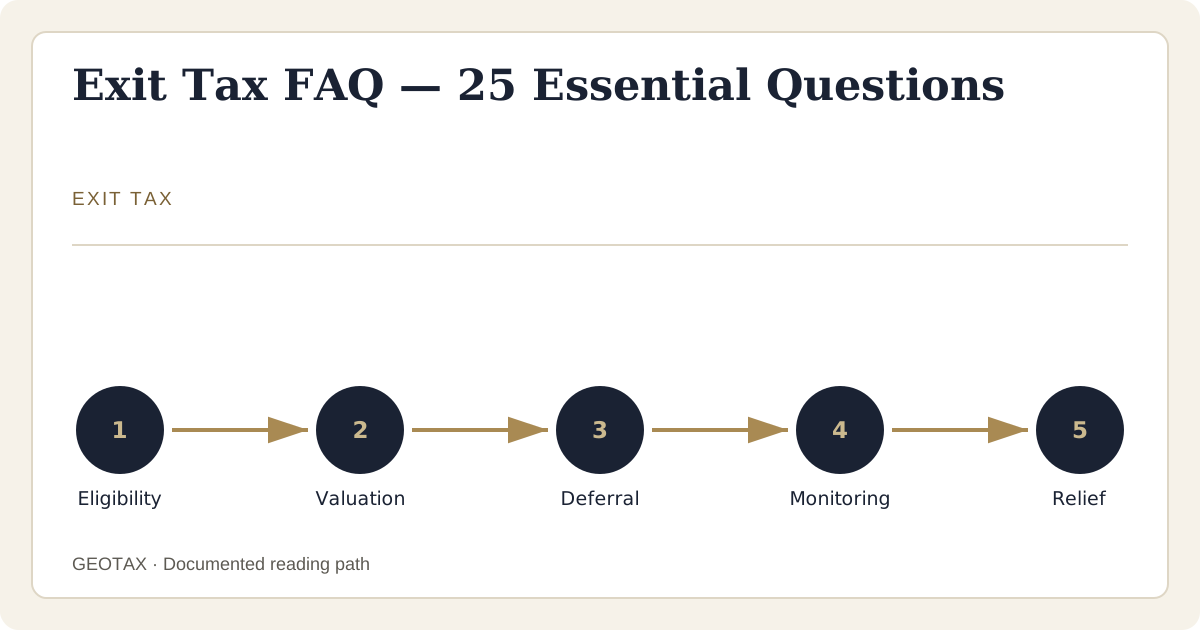
Frequently asked questions on scope of application, computation, deferral (Section IV and Section V), guarantees, the fiscal representative, relief, crypto-assets, BSPCEs, and specific issues for the France–UAE corridor.
Scope of Application and Conditions
Who is subject to the exit tax?
Any individual transferring their tax residence outside of France who has been a French tax resident for at least six of the ten years preceding the transfer, and who holds, directly or indirectly with the members of their tax household, either an ownership interest of at least 50% in the corporate profits of a company or securities falling within the scope of article 150-0 A of the French General Tax Code (CGI) with an aggregate value exceeding 800,000 euros (Article 167 bis, I of the CGI). Gains already in tax deferral are taxable whatever the duration of residence.
Does a departure to Dubai trigger the exit tax?
Yes. The exit tax applies to any transfer to any foreign State, including the United Arab Emirates. The applicable deferral regime, however, is not the automatic deferral under Section IV (reserved for the EU and States that have concluded with France the required fraud-assistance and recovery-assistance conventions) but the elective deferral under Section V, the France-UAE treaty of 19 July 1989 containing no recovery-assistance clause.
Does the exit tax reach my primary residence?
No. The exit tax applies to unrealized capital gains on corporate rights, securities, or equivalent instruments. Real estate held directly by the taxpayer falls outside its scope.
Are my cash holdings in bank accounts covered?
No. Cash holdings do not generate any unrealized capital gain.
Computation
What is the applicable rate?
Under the single flat-rate withholding (PFU, the default regime in 2026), the aggregate rate is 31.4% (12.8% income tax + 18.6% social contributions). The election for the progressive income-tax brackets is available but triggers the application of those brackets to all the taxpayer's investment income for the year.
How do I value a privately held company?
Through a combination of methods: discounted cash flows, multiples drawn from comparable transactions, intrinsic value, and asset-based value. An independent valuation report prepared before departure is strongly recommended.
Do the holding-period allowances apply?
Only for securities acquired before January 1, 2018, and only if the taxpayer elects the progressive bracket regime. Three tiers: 50%, 65%, and 85% (the enhanced SME tier).
Deferral
Is the automatic deferral under Section IV available for Dubai?
No. The UAE does not satisfy the two-pronged condition required by Section IV. Only the elective deferral under Section V is available.
What is the deadline to propose guarantees?
Ninety days before the transfer (Decree 2019-868). This deadline is not negotiable.
What types of guarantees are accepted?
Bank guarantee, pledge of securities, mortgage, cash deposit, or personal guarantee of a solvent third party.
Is the fiscal representative mandatory?
Yes, under Section V (elective deferral). No, under Section IV (automatic deferral).
Monitoring and Filings
What annual forms are required?
Form 2074-ETS1 (transfers from 3 March 2011 to 31 December 2012), ETS2 (transfers in 2013), ETS3 (transfers since 1 January 2014), and ETSL (simplified return, full deferral with no event during the year). Since 2019, annual filing is waived where the deferral covers only unrealised gains: the return is then due only upon an event.
What happens if I sell part of my securities?
Proportional forfeiture of the deferral. The tax attributable to the portion sold becomes immediately due and payable. Notification is made via Form 2074-ETS.
Does a gift of my securities trigger forfeiture of the deferral?
The effect of a gift on the deferral and relief depends on the category of gain, the donor's State of residence and the conditions in section VII of article 167 bis. Where the statute requires it, the taxpayer must demonstrate that the gift was not made for principally tax reasons. The applicable version of the law and the facts must be reviewed before any gift.
Relief
When can I obtain relief?
After 2 years below EUR 2.57M or 5 years above it for departures since 2019, provided that the securities have been retained and the applicable reporting duties met. At exactly EUR 2.57M, the CGI and the 2026 Form 2074-ETS3 diverge, so confirmation from the competent tax office is required.
Is relief granted automatically?
It is granted automatically by law, but in practice requires the filing of follow-up Form 2074-ETS3 (box 430) with evidence that the securities have been retained. A return to France before the expiration of the holding period also triggers relief as of right.
Crypto-Assets
Are my crypto-assets within the scope of the exit tax?
Crypto-assets held directly by an individual taxpayer fall, in principle, outside the scope of article 167 bis CGI. By contrast, securities representing an interest in a digital-asset management company may fall within scope.
Specific Situations
Am I subject to the exit tax if I am leaving France for the first time after only five years?
No for unrealised gains and earn-out claims: the condition of six years out of the prior ten is not met. Beware, however: gains already in tax deferral (notably under Article 150-0 B ter) remain taxable whatever the duration of residence (Article 167 bis, II of the CGI).
What if I am an inbound expatriate (impatrié) leaving France?
If you have not been a French tax resident for at least 6 of the previous 10 years, you fall outside the scope of the exit tax.
Are my BSPCEs (founder warrants) covered?
Yes, if they have been exercised and you hold the underlying shares on the date of transfer. The acquisition price used for the unrealised-gain computation is the value of the share on the date the warrant was exercised; the exercise gain (difference between that value and the subscription price set at grant) remains taxed separately under the regime of Article 163 bis G of the CGI (BOI-RPPM-PVBMI-50-10-10-20).
I am not a French national but I am a tax resident of France. Am I covered?
Yes. The exit tax turns on tax residence, not on nationality. Any French tax resident leaving France and meeting the conditions falls within scope.
Tailored Exit Tax Audit
A one-hour videoconference to review your situation, calibrate your exit tax exposure, and secure your transfer to Dubai. Fee: 2,000 AED (approx. €470).
Book an auditSources & case law
References current as at the date of last revision, cited for information only. Any application to a particular situation requires an individualised analysis.
Legislation
- Article 167 bis CGI (exit tax, transfers since 3 March 2011); Article 238-0 A CGI (non-cooperative States list); Article 41 tervicies E of Annex III to the CGI.
- Décret n° 2019-868 of 21 August 2019 (on-election deferral, proposal of guarantees).
Administrative doctrine (BOFiP)
- BOI-RPPM-PVBMI-50 (exit tax); -50-10-30 (deferral); -50-10-40 (relief); -50-10-50 (reporting obligations, Forms 2074-ETD / 2074-ETS). (historical archived guidance; cross-check against the CGI, implementing rules and current 2026 forms/notices)
Case law
- CE, 9th–10th Ch., 15 December 2025, No. 495783 — the deferral suspends the limitation period for recovery; a reporting failure restores immediate enforceability only after an unanswered formal notice to regularise.
- CE, 5 February 2025, No. 476399 — limits on the retroactivity of the exit tax under EU law.
- ECJ, 11 March 2004, de Lasteyrie du Saillant, C-9/02; CE, 10 November 2004, No. 211341; CE, 29 April 2013, No. 357576; CE, 20 May 2022, No. 449038.
Key points
Frequently asked questions on scope of application, computation, deferral (Section IV and Section V), guarantees, the fiscal representative, relief, crypto-assets, BSPCEs, and specific issues for the France–UAE corridor.
Page references: 167 bis CGI · Décret n° 2019-868 of 21 August 2019