Tax Residence in the United Arab Emirates: Criteria, Procedure and Key Issues
Establishing tax residence in the United Arab Emirates is assessed by reference to the criteria set out in Cabinet Decision No. 85/2022 of the UAE. A Tax Residency Certificate (TRC) issued by the Federal Tax Authority constitutes a useful evidentiary element but does not by itself settle a residence analysis, in particular where a residence conflict with France arises. The concrete tax treatment of a given situation depends on the qualification of each item of income, on the application of the France-UAE tax treaty of 19 July 1989 and on the facts and circumstances of the case.
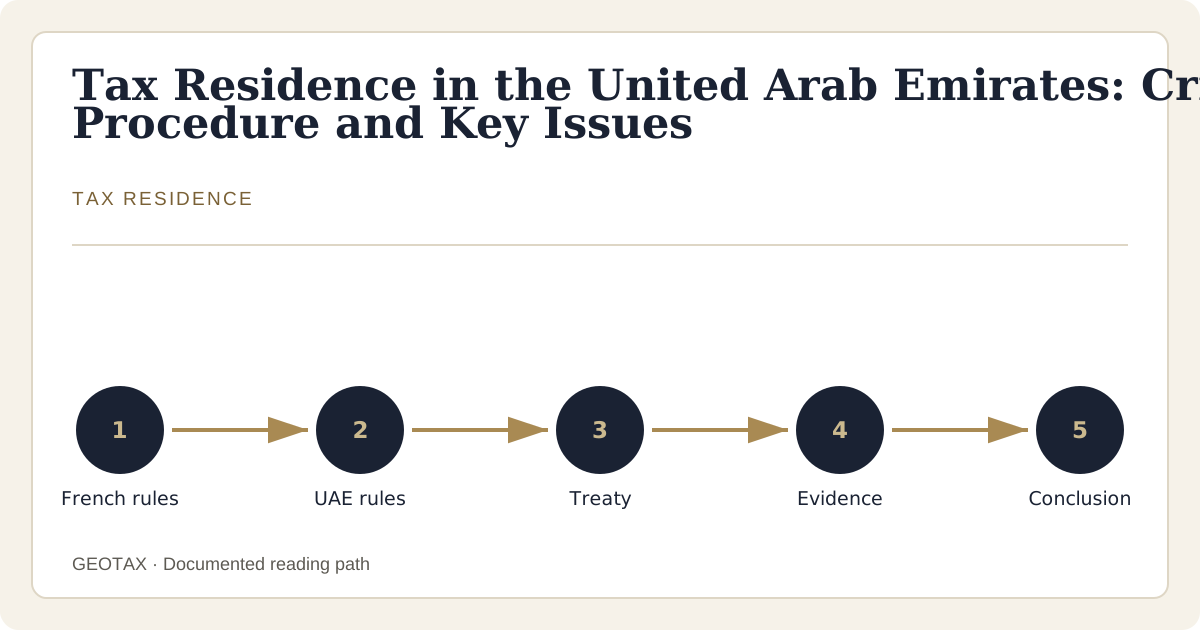
UAE tax residence must be presented with a clear distinction between natural persons and juridical persons. For natural persons, the legislation provides for: habitual residence with the centre of financial and personal interests in the State; or physical presence of at least 183 days over a 12-month period; or, in certain cases, presence of at least 90 days over 12 months combined with additional conditions relating to residence permit, permanent home or employment/business in the State. Criteria for juridical persons must not be merged with those applicable to natural persons. In case of dual residency, the France-UAE Tax Treaty of July 19, 1989 (Article 4(2)) resolves conflicts through a successive hierarchy: permanent home → centre of vital interests → habitual abode → nationality → mutual agreement between the competent authorities.
Tax Residence silo contents
This pillar page provides an overview. Each topic has a dedicated page covering the rules, deadlines and best practices in depth.
The Three Criteria for Tax Residency in the UAE (Natural Persons)
The page should keep a strict distinction between natural persons and legal persons. For natural persons, the relevant UAE criteria include the usual place of residence and centre of personal and financial interests, or 183 days, or in certain cases 90 days together with additional conditions. The criteria applicable to juridical persons, which turn principally on incorporation, effective management and specific provisions of the UAE Corporate Tax framework, must not be merged with those applicable to natural persons and are not the object of this section.
Tax residence under UAE domestic law for natural persons is determined by reference to the criteria set forth in Cabinet Decision No. 85/2022. Satisfaction of a single criterion may, in principle, be sufficient to qualify the taxpayer as a UAE tax resident under domestic criteria; a cumulative approach, where the facts allow, reinforces the evidentiary basis of the position, without however settling, on its own, a dual-residence conflict with France, which is determined by reference to the criteria of Article 4 B of the French General Tax Code and, where applicable, to the tie-breaker rules of the France-UAE tax treaty.
Criterion 1 — Usual or Primary Place of Residence and Centre of Interests
A person is considered a UAE tax resident if their usual or primary place of residence and the centre of their financial and personal interests are in the State (Cabinet Decision No. 85/2022, Article 4(1)). Ministerial Decision No. 27/2023 (Article 2) clarifies that the usual place of residence is the jurisdiction where the person spends most of their time as part of their settled routine, and that the centre of interests is assessed by reference to the place of occupation, familial and social relations, cultural activities, place of business and place from which the person's property is administered. This criterion rests on factual analysis: accommodation (ownership or long-term rental), effective residence therein, concentration of interests. France applies comparable criteria (Article 4 B of the French Tax Code): the French tax authorities will scrutinise the nature of the housing, its availability and the relationships maintained.
Key points:
- Housing held or rented under a stable lease (long-term arrangements provide stronger evidence)
- Effective and continuous residence, documented by a body of consistent factual elements
- Economic and patrimonial interests concentrated in the UAE
- Absence of a French foyer or principal dwelling (liquidation of French housing or proven relocation)
Criterion 2 — Physical Presence of 183 Days
The 183-day threshold is one of the criteria retained under UAE domestic law, within the framework of Cabinet Decision No. 85/2022, for the determination of UAE tax residence in certain situations. It should not, however, be presented as a universal rule sufficient on its own to settle a residence analysis under French law or under a bilateral tax treaty: the existence of UAE tax residence under domestic criteria does not, by itself, resolve a dual-residence conflict with France, which is determined by reference to the criteria of Article 4 B of the French General Tax Code and, where applicable, to the tie-breaker rules of the France-UAE tax treaty of 19 July 1989.
Key points:
- Accumulate at least 183 days within a 12-consecutive-month period (Cabinet Decision No. 85/2022, Article 4(2))
- Every day or part of a day of physical presence counts (Ministerial Decision No. 27/2023, Article 3)
- Days need not be consecutive: partial days, weekends and temporary stays are included
- Document each entry and exit (passport stamps, immigration records)
- No housing condition attaches to this criterion: physical presence alone is decisive
Criterion 3 — 90 Days with Qualifying Conditions
A person is considered a UAE tax resident if they accumulate at least 90 days of physical presence over 12 consecutive months, provided that (i) they are a UAE national, hold a valid UAE Residence Permit or hold the nationality of a Gulf Cooperation Council member state, and (ii) they either have a Permanent Place of Residence in the UAE or carry on an employment or business in the UAE (Cabinet Decision No. 85/2022, Article 4(3)). The Permanent Place of Residence means any furnished dwelling continuously available to the person, with no ownership requirement (Ministerial Decision No. 27/2023, Article 5); the notion of employment is defined by Article 6 of the same decision.
Key points:
- Required status: UAE national, holder of a valid Residence Permit, or GCC national
- Minimum 90 days of physical presence within 12 consecutive months (days or parts of days)
- And, alternatively: a Permanent Place of Residence in the UAE, or an employment or business carried on in the UAE
- Combining several elements strengthens the evidentiary basis and limits administrative challenges
Criterion 1
Residence + Interests
Permanent residence and center of economic interests in the UAE
Criterion 2
183 Days
Cumulative physical presence over any 12-month period, as a UAE domestic criterion
Criterion 3
90 Days + Links
Resident visa + 90 days + qualifying links
The Tax Residency Certificate (TRC)
A UAE Tax Residency Certificate is a strong and often highly useful piece of evidence, but it should not be presented as conclusive in every cross-border situation. In a France-UAE context, the overall factual pattern and the treaty analysis may still need to be reviewed. The TRC is an official administrative document issued by the Federal Tax Authority (FTA) of the United Arab Emirates. Obtaining a TRC is strongly recommended because it substantially reduces the risk of challenge by French authorities in the event of tax audit, without being, by itself, dispositive of a residence analysis detached from the facts of the case.
Procedure for Obtaining a TRC from the FTA
The application process is conducted directly with the FTA online or in person. The principal steps are:
- 1. FTA Registration: Create an account on the FTA's EmaraTax platform (accessible via tax.gov.ae) using your Emirates ID or UAE Pass.
- 2. TRC Application Filing: Complete the tax residency certificate application form for the relevant period (Cabinet Decision No. 85/2022, Article 5). The FTA verifies that the criteria of Articles 3 or 4 of the decision are met (residence permit, physical presence, qualifying conditions).
- 3. Processing Time: since its 11 August 2026 update, the FTA announces 10 business days from receipt of a complete application; check the current timeframe when applying.
- 4. Issuance: The TRC is issued in electronic format (digitally signed PDF) and may be printed or transmitted directly to third parties.
Required Documents
- Valid Emirates ID (UAE identity card)
- Valid UAE resident visa (proof of lawful physical residence)
- Proof of UAE domicile (lease agreement, title deed, or sponsor declaration)
- Prior year tax return (if applicable)
- For salaried employees: employment contract and pay slips
- For self-employed/businesses: copy of commercial registration, accounting records
Costs and Timeframes
The administrative fees and the processing times for a TRC application depend on the fee schedule and the operational practices of the Federal Tax Authority in force at the date of the application, and are subject to adjustment over time. It is therefore recommended to verify the applicable fees and timeframes directly on the FTA portal (tax.gov.ae, EmaraTax platform) prior to filing.
A UAE Tax Residency Certificate is a strong and often highly useful piece of evidence, but it should not be presented as conclusive in every cross-border situation. In a France-UAE context, the overall factual pattern and the treaty analysis may still need to be reviewed.
Need expert guidance?
Let's discuss your situation
Free 10-minute initial call. Jonathan Sémon responds personally.
Book a consultationThe France-UAE Tax Treaty and tax residence
The France-UAE treaty provides treaty rules for allocating taxing rights and mechanisms aimed at avoiding double taxation, but their practical effect depends on the exact nature of the income, the treaty residence analysis and the circumstances of the case. The France-UAE tax treaty of 19 July 1989 (published in France by décret n° 90-631 du 13 juillet 1990) provides, at its Article 4(2), tie-breaker rules intended to resolve situations of dual residence, and, at its Articles 19 (French side, tax credit method) and 20 (UAE side, reference to domestic legislation), mechanisms for the elimination of double taxation. The concrete effect of the treaty in a given situation does not derive automatically from its signature: it depends on the qualification of each item of income, on the application of the tie-breaker rules to the facts of the case and on the consistent application of the treaty by each State, taking into account the administrative guidance published by the French tax administration (BOFiP, BOI-INT-CVB-ARE).
Tie-breaker rules under Article 4 of the 1989 Treaty
Where, under the domestic law of each State, a person is treated as a resident of both France and the United Arab Emirates, Article 4(2) of the 1989 Treaty prescribes a sequential series of tests by reference to which that person's treaty residence is to be determined: permanent home, centre of vital interests, habitual abode, nationality and, as a final step, mutual agreement between the competent authorities. These tests must be examined successively, in order, and not alternatively (Conseil d'État, 29 October 2012, No. 346641). Their application is inherently factual and must be conducted on a case-by-case basis.
Articulation with French domestic law
French tax residence is determined under the criteria of Article 4 B of the French General Tax Code (CGI). Since the Finance Act for 2025 (Law No. 2025-127 of 14 February 2025, Article 83), that article expressly provides that a person meeting the domestic criteria cannot be regarded as having their tax domicile in France where, under an international double-taxation treaty, they are not regarded as a resident of France. The primacy of treaty provisions over French domestic law derives from Article 55 of the French Constitution, subject to the case-law of the French supreme courts (see, in particular, CE, ass., 28 June 2002, n° 232276, Sté Schneider Electric). The practical consequence is that, where a person is treated as a UAE resident under the tie-breaker rules of Article 4 of the 1989 Treaty, the French tax administration is, in principle, required to draw the consequences thereof, subject, however, to the text of each treaty provision and to the facts of the case. A careful contemporaneous documentation of the transfer of the foyer and of the centre of economic interests remains essential.
Elimination of double taxation
The mechanisms for the elimination of double taxation provided for by the Treaty (Article 19 on the French side, Article 20 on the UAE side) do not purport to exempt income from taxation in all cases: they allocate taxing rights between the two States. On the French side, Article 19(1) provides a tax credit whose amount varies with the income category: equal to the tax actually paid in the UAE for real-estate gains and disposals of substantial participations (Treaty, Art. 11(1) and (3)), and equal to the corresponding French tax for other income — without any requirement of effective taxation in the UAE (Conseil d'État, 20 March 2023, No. 452718). The availability and extent of relief depend on the qualification of the income under the Treaty, on the treaty residence of the taxpayer and on the domestic law of each State.
Pitfalls to Avoid
Establishing tax residency in the UAE carries risks of incorrect qualification or administrative challenge. The most common errors:
1. Insufficient Physical Presence
Invoking the 183-day criterion while accumulating a materially lower number of days of physical presence in the UAE, or continuing to maintain in France elements characteristic of a foyer (family home, significant personal property held, ongoing activity), weakens the position under UAE domestic criteria and exposes the taxpayer to challenge by the French tax administration as to the effective location of his residence. The evidentiary weight of each element is assessed on a case-by-case basis by reference to the criteria of Article 4 B of the French General Tax Code.
2. Maintained Links in France
Retaining salaried employment in France, a professional activity based in France, a French family home (spouse, children), or significant assets (real property) suggests to French authorities that your center of interests remains French. Liquidate or dispose of these links before or concurrent with your departure.
3. Lacunose or Contradictory Documentation
Absence of lease or property purchase agreement in the UAE, lack of proof of presence (visa stamps, airline records), no UAE tax return, or inconsistency between French and actual situation (e.g., departure declared in 2023 but 200 days in France in 2024) expose you to assessments.
4. Premature TRC Request
Requesting a TRC before you have concretely satisfied the criteria (fewer than 90 days physical presence, still owning in France, children in France) risks delegitimizing your file. Await 12 months following effective change of residency to consolidate your position.
5. Neglect of French Reporting Obligations
In the year of departure, you remain taxable in France on your worldwide income up to the date of the transfer of your tax domicile, and thereafter only on your French-source income (Articles 167 and 164 B of the French Tax Code). A return must be filed the year following departure, and French-source income received after departure remains reportable as a non-resident. Omission results in surcharges (Articles 1728 and 1729 of the French Tax Code).
GEOTAX Support
GEOTAX assists entrepreneurs, investors, and expatriates in securing their tax residency in the UAE. Our approach combines legal advice, administrative assistance, and regulatory monitoring.
Personalized Situation Analysis
We evaluate your profile against the three criteria, identify risks vis-à-vis France, and propose a residency transition strategy tailored to you. We clarify whether the 183-day test, permanent dwelling, or qualifying links criterion is most robust for your situation.
TRC Acquisition Assistance
We manage the FTA process: file preparation, registration, administrative follow-up, and certificate procurement. We also manage apostille if you must present the TRC to French authorities.
Legal Monitoring and Updates
Tax residency regimes evolve regularly (new Cabinet Decision, convention amendment, DGFIP circulars). We keep you informed of changes and adapt your situation accordingly.
Coordination with Your French Advisor
If assisted by a French attorney or accountant, we coordinate our action to ensure consistency and compliance with both jurisdictions.
Key Takeaways
- Three alternative or cumulative criteria establish tax residency in the UAE (Cabinet Decision 85/2022)
- The 183-day test is automatic and objective; the other two rest on factual analysis
- TRC is a major evidentiary element, very useful in practice, but does not by itself settle a residence analysis in the event of a conflict with France
- The France-UAE convention provides tie-breaker criteria, but their application depends on the taxpayer's exact situation and overall facts and circumstances
- Document your residency change: property agreement, resident visa, physical presence, France liquidation
- Respect French reporting obligations in the year of departure and for non-resident income
- Avoid common errors: insufficient presence, maintained France links, lacunose documentation
Frequently Asked Questions
References
- Cabinet Decision No. 85 of 2022 (determination of UAE tax residency, effective 1 March 2023) — tax.gov.ae (PDF)
- Ministerial Decision No. 27 of 2023 (implementation: day counting, permanent place of residence, employment) — mof.gov.ae (PDF)
- Article 4 B of the French Tax Code (as amended by Law No. 2025-127 of 14 February 2025, Article 83) — Légifrance
- France-UAE tax treaty of 19 July 1989 (Decree No. 90-631 of 13 July 1990) — Légifrance
- BOI-INT-CVB-ARE — French administrative guidance on the France-UAE treaty — BOFiP
- Conseil d'État, 20 March 2023, No. 452718 — Légifrance
Secure Your Tax Residency in the UAE
Anticipating risks and documenting your residency change requires legal and tax expertise. Our consultants support you at each step, from initial analysis to TRC acquisition and management of reporting obligations.
Tax sources and review date
Fiscal review: 5 September 2026. The applicable text and tax period must be checked for each situation.