France-UAE Tax Treaty: Comprehensive Analysis and Application
The tax treaty between France and the United Arab Emirates, signed in Abu Dhabi on 19 July 1989 and amended by the protocol of 6 December 1993 (decrees No. 90-631 of 13 July 1990 and No. 95-798 of 14 June 1995), is the cornerstone of the elimination of double taxation between the two States. Its application requires combined expertise of both tax systems.
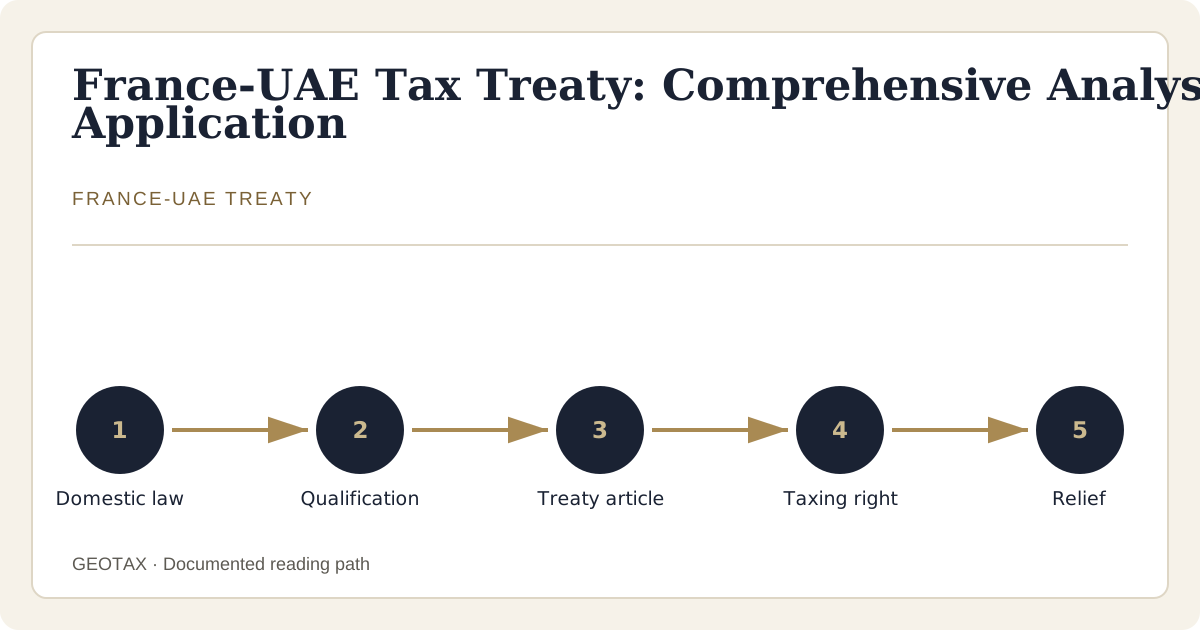
The France-UAE Tax Treaty, signed on July 19, 1989, provides a framework for allocating taxing rights between the two states, which articulates with each state's domestic tax law to determine tax liability. Article 4(2) sets out successive tie-breaker criteria (permanent home → centre of vital interests → habitual abode → nationality → mutual agreement) to address dual-residency situations, though the practical effect of such allocation depends on the prior determination of residency under each State's domestic law. The actual tax outcome depends on the applicable wording, the nature of the income, treaty residence and the domestic law of each State. Transferring one's tax domicile to the UAE — a State outside the European Economic Area with no mutual assistance agreement with France for tax recovery — excludes the automatic deferral of the French exit tax (Article 167 bis, IV of the French Tax Code): deferral is only available upon request, with guarantees (Article 167 bis, V). Reporting obligations also apply, notably the declaration of foreign bank accounts (Article 1649 A of the French Tax Code).
Treaty History and Scope of Application
Signed at Abu Dhabi on 19 July 1989, the France-UAE tax treaty was published in French law by decree No. 90-631 of 13 July 1990 (approved by law No. 90-333 of 10 April 1990) and entered into force on 1 July 1990. It was amended by an avenant signed on 6 December 1993, published by decree No. 95-798 of 14 June 1995 (approved by law No. 94-881 of 14 October 1994), which entered into force on 1 June 1995.
Territorial Scope
The treaty applies to individuals and legal entities that are residents of France or of the United Arab Emirates, or of both States (Article 1). On the French side, it covers the European and overseas départements of the Republic (Article 23(1)); it does not extend, absent an extension agreement by exchange of diplomatic notes, to other French overseas collectivities (Article 23(2)). On the Emirati side, it covers the entire territory of the federation (Abu Dhabi, Dubai, Sharjah, Ajman, Umm Al Quwain, Ras Al Khaimah, Fujairah).
Status: Supralegislative Treaty
In France, the treaty has an authority superior to that of domestic statute law (French Constitution of 4 October 1958, Article 55). Since the Finance Act for 2025 (Law No. 2025-127 of 14 February 2025, Article 83), Article 4 B of the French Tax Code (CGI) expressly enshrines this primacy: a person regarded as a resident of the UAE within the meaning of the treaty cannot be considered as having their tax domicile in France under domestic law. Case law nevertheless requires that the taxpayer's position first be established under domestic law before the treaty tie-breaker criteria are applied (subsidiarity principle: Conseil d'État, 11 April 2008, No. 285583).
Determination of Tax Residence
Article 4(1) of the treaty defines residence asymmetrically: on the French side, a resident is any person liable to tax in France by reason of domicile, residence, place of management or any other criterion of a similar nature; on the Emirati side, any person who is domiciled, established or has its place of management in the UAE — with no requirement of liability to tax. Where an individual is a resident of both States under those definitions, Article 4(2) provides subsidiary tie-breaker criteria, which must be examined successively, in order, and not alternatively (Conseil d'État, 29 October 2012, No. 346641).
| Criterion | Priority Order | Application |
|---|---|---|
| Permanent home (Art. 4(2)(a)) | 1 | Dwelling available to the person on a durable basis, at all times (owned, rented or made available) |
| Centre of vital interests (Art. 4(2)(a)) | 2 | State with which personal and economic ties are closest |
| Habitual abode (Art. 4(2)(b)) | 3 | Frequency, duration and regularity of stays (Conseil d'État, 16 July 2020, No. 436570) |
| Nationality (Art. 4(2)(c)) | 4 | If habitual abode in both States or in neither |
| Mutual agreement (Art. 4(2)(d)) | 5 | The competent authorities of the two States settle the question by mutual agreement |
Practical Case: Double Residence
A person with a permanent home available in both France and the UAE is deemed resident of the State with which their personal and economic ties are closest — the centre of vital interests (Treaty, Art. 4(2)(a)). If that centre cannot be determined, residence is allocated to the State of habitual abode, assessed by reference to the frequency, duration and regularity of stays, without it being necessary for their total duration to exceed half the year (Conseil d'État, 16 July 2020, No. 436570). The taxpayer must document each criterion.
Taxation of Income from Specific Sources
The treaty enumerates income categories and determines, for each, whether the taxing right belongs to the source State or the residence State. Since the protocol of 6 December 1993, in force since 1 June 1995, dividends, income from debt-claims and royalties are taxable exclusively in the beneficial owner's State of residence, with no withholding tax. However, for payments made on or after 1 January 2026, the French paying agent must levy the domestic withholding tax at source (FTC, art. 119 bis A, II, enacted by the 2025 Finance Act; rates of art. 187), the UAE being among the covered jurisdictions; the recipient may then claim a refund from the French non-resident tax directorate upon evidence of UAE residence, beneficial ownership and the other treaty conditions (BOI-INT-DG-20-20-20-30, 16 March 2026). Forms 5000/5001 and cash-flow timing must be anticipated.
Employment Income (Article 13)
Salaries, wages and similar remuneration from private employment are taxable in the State where the employment is exercised (Treaty, Art. 13(1)). By exception, they remain taxable only in the employee's State of residence if three conditions are met: presence not exceeding 183 days in the other State during the relevant fiscal year, an employer who is not a resident of that other State, and remuneration not borne by a permanent establishment or fixed base situated there (Treaty, Art. 13(2)). For a French resident exercising employment in the UAE, Article 19(1) grants a tax credit equal to the corresponding French tax, without making that credit conditional upon the salary being effectively taxed in the UAE (Conseil d'État, 20 March 2023, No. 452718).
Business Profits and Independent Professions (Articles 6 and 12)
The profits of an enterprise of one State are taxable only in that State, unless it carries on business in the other State through a permanent establishment situated there (Treaty, Art. 6(1)). The permanent establishment is defined in Article 4 A, created by the 1993 protocol: a fixed place of business — place of management, branch, office, factory, workshop — and a building or assembly site lasting more than six months (Treaty, Art. 4 A(3)). Income from independent professions is taxable only in the State of residence, unless the professional habitually has a fixed base in the other State (Treaty, Art. 12).
Investment Income: Dividends, Income from Debt-Claims, Royalties (Articles 8, 9 and 10)
Since the protocol of 6 December 1993, dividends (Treaty, Art. 8), income from debt-claims (Treaty, Art. 9) and royalties (Treaty, Art. 10) are taxable only in the beneficial owner's State of residence: the 5% withholding tax previously applicable to certain dividends and interest was abolished with effect from 1 June 1995. For French-source dividends paid on or after 1 January 2026, however, the French paying agent levies the domestic withholding tax notwithstanding the treaty (FTC, art. 119 bis A, II, enacted by the 2025 Finance Act; rates of art. 187), the UAE-resident recipient claiming a refund from the French non-resident tax directorate upon evidence of the treaty conditions (BOI-INT-DG-20-20-20-30, 16 March 2026; forms 5000/5001). These items also become taxable in the source State, under the business profits or independent professions rules, where they are effectively connected with a permanent establishment or fixed base situated there (Treaty, Art. 8(5), 9(4) and 10(3)). The practical effect depends on the exact qualification of the income, treaty residence and the domestic law of each State: a case-by-case analysis remains necessary.
Capital Gains (Article 11)
Gains from the alienation of immovable property are taxable in the State where the property is situated (Treaty, Art. 11(1)(a)), as are gains on shares of companies whose assets consist of more than 80% of immovable property or rights relating thereto (Treaty, Art. 11(1)(b)). Gains on other assets are taxable only in the seller's State of residence (Treaty, Art. 11(2)), except for disposals of substantial participations — shares entitling the holder, directly or indirectly, to more than 25% of a company's profits — which are taxable in the State of which the company is a resident (Treaty, Art. 11(3)). Caution: for a French resident selling property located in the UAE, the tax credit under Article 19(1) equals the tax actually paid in the UAE, capped at the corresponding French tax; absent any UAE taxation of the gain, the French tax remains fully due.
Foreign Tax Credit and Articulation with Domestic Law
The treaty provides for conventional mechanisms for allocating taxing rights and eliminating double taxation. Their practical effect depends on the nature of the income, its qualification, the treaty residence and the circumstances of the case.
French Method: Tax Credit (Article 19(1))
For a French resident, Article 19(1) first concerns income that the treaty permits the UAE to tax. For the expressly listed categories, including certain Article 11 gains, the credit is limited to UAE tax actually paid and the corresponding French tax. For other income falling within this mechanism, such as Article 5 rents or certain Article 13 salaries, the credit equals the corresponding French tax without requiring actual UAE taxation. A UAE dividend under Article 8 received by its beneficial owner resident in France is generally taxable only in France: Article 19 does not provide a credit cancelling that tax. Pensions taxable exclusively in the residence State also require separate treatment. Classify each income category before completing Form 2047.
UAE Method: Reference to Domestic Law (Article 20)
On the Emirati side, Article 20 provides that double taxation is avoided in accordance with UAE legislation. As the UAE levies no personal income tax, the question does not arise in practice for individuals resident in the UAE. For companies, the 9% Corporate Tax (above AED 375,000 of taxable income, Federal Decree-Law No. 47 of 2022, Article 3) contains its own foreign tax credit mechanism under domestic law.
Article 19(2): Specific Anti-Abuse Clause
Where a person resident or established in the UAE remains domiciled in France for tax purposes under French domestic law, or is a subsidiary controlled directly or indirectly as to more than 50% by a company whose place of management is in France, that person's income remains taxable in France notwithstanding any other provision of the treaty, France then crediting any tax levied by the UAE (Treaty, Art. 19(2)). This clause does not apply to individuals who are UAE citizens. Its articulation with the treaty primacy now enshrined in Article 4 B of the French Tax Code (Law No. 2025-127 of 14 February 2025, Article 83) calls for a case-by-case analysis.
Wealth tax and succession duties under the 1989 Convention
Contrary to a widely held misconception, the material scope of the France-UAE Convention of 19 July 1989 (published in France by décret n° 90-631 of 13 July 1990) is not limited to income taxes. The taxes covered by the Convention, set out in its Article 2, include income taxes, wealth tax and succession duties, as confirmed by the French tax administration's published guidance (BOFiP, série BOI-INT-CVB-ARE). The practical articulation of these rules with each State's domestic law must be examined on a case-by-case basis.
Wealth tax (impôt sur la fortune immobilière)
Article 16 A allocates wealth-taxing rights. Real estate in the other State may be taxed there, subject to the mechanism for certain financial investments of at least equal value held permanently. The treaty defines permanence by holding for more than eight months during the preceding calendar year (Article 16 A(1) and (6)(a)). Any reliance on the most-favoured-nation clause in paragraph 5 requires the relevant third-country text, its conditions and effective date; a shorter period must not be assumed. Application to French IFI, which replaced ISF, requires examination of residence, assets and treaty conditions.
Succession and gift duties
Article 17 of the Convention allocates taxing rights over successions: immovable property is subject to succession duties only in the State where it is situated (Treaty, Art. 17(1)); movable property effectively connected with a permanent establishment or fixed base is taxable only in the State where that establishment is situated (Treaty, Art. 17(2)); all other movable property, tangible and intangible — including securities and deposits — is taxable only in the State of which the deceased was a resident at the time of death (Treaty, Art. 17(3)). On the French side, assets taxable in the UAE under the Convention are exempt in France, subject to the effective-rate rule (Treaty, Art. 19(4)), by derogation from the territoriality rules of Article 750 ter of the CGI. Because the United Arab Emirates levies no succession duties under its domestic law, the mechanism operates essentially unilaterally on the French side. Gifts, by contrast, are not covered by the Convention (Treaty, Art. 2): French domestic rules apply in full (Articles 750 ter and 784 A of the CGI). A case-by-case analysis in light of the administrative guidance (BOFiP, BOI-INT-CVB-ARE) remains necessary.
Recent international tax developments and the France-UAE Treaty
The MLI modifies the application of certain bilateral treaty provisions. Use the DGFiP synthesised text alongside the authentic texts and applicable notifications. Pillar Two and CRS automatic exchanges are separate frameworks; UAE DMTT applies within its own scope to fiscal years beginning on or after 1 January 2025.
OECD 15% Global Minimum Tax (Pillar Two)
The OECD/G20 Inclusive Framework agreement of October 2021 introduces a 15% minimum effective tax rate for multinational groups with consolidated revenue of EUR 750 million or more. France transposed the GloBE rules through Articles 223 VJ et seq. of the CGI, enacted by the Finance Act for 2024. The UAE introduced a 15% Domestic Minimum Top-up Tax through Cabinet Decision No. 142 of 2024, applicable to financial years starting on or after 1 January 2025 and limited to entities that are members of multinational groups meeting that threshold. In practice, for individual structures and small non-consolidated companies, the UAE Corporate Tax remains at the standard 9% rate above the AED 375,000 threshold (Federal Decree-Law No. 47 of 2022, Article 3), with no top-up tax.
French anti-abuse rules and the France-UAE Treaty
The France–UAE treaty must be read together with the changes made by the BEPS Multilateral Convention (MLI). The DGFiP synthesised text includes a principal purpose test (PPT): treaty relief may be denied where obtaining it was one of the principal purposes of an arrangement or transaction, unless granting it accords with the object and purpose of the relevant provisions. MLI effects must be checked by tax and period, rather than inferred from the date of the original 1989 treaty. The analysis combines treaty conditions, actual residence, substance and applicable French anti-abuse rules, including LPF Articles L.64 and L.64 A and, where relevant, CGI Article 123 bis.
Need expert guidance?
Let's discuss your situation
Free 10-minute initial call. Jonathan Sémon responds personally.
Book a consultationFrequently Asked Questions
References
- France-UAE tax treaty of 19 July 1989, published by Decree No. 90-631 of 13 July 1990 — Légifrance
- Consolidated treaty text (protocol of 6 December 1993) — impots.gouv.fr (PDF)
- BOI-INT-CVB-ARE — French administrative guidance on the France-UAE treaty — BOFiP
- Article 4 B of the French Tax Code (as amended by Law No. 2025-127 of 14 February 2025, Article 83) — Légifrance
- Article 167 bis of the French Tax Code (exit tax) — Légifrance
- Conseil d'État, 20 March 2023, No. 452718 (credit for UAE-source salaries not conditional upon effective taxation) — Légifrance
- Federal Decree-Law No. 47 of 2022 (UAE Corporate Tax) — Federal Tax Authority
Optimize Your France-UAE Tax Situation
Treaty application requires precise analysis of your residency status, income sources, and reporting obligations. Our tax lawyers ensure correct treaty interpretation and minimize your overall tax burden.
Tax sources and review date
Fiscal review: 5 September 2026. The applicable text and tax period must be checked for each situation.