Company Formation in Dubai: Legal and Tax Structuring
Setting up in the UAE is more than obtaining a business license: choosing between Free Zone and Mainland determines your tax regime, operational scope, and long-term sustainability. At GEOTAX, we guide every step of your incorporation with legal expertise and strategic tax vision.
Key points
Setting up in the UAE is more than obtaining a business license: choosing between Free Zone and Mainland determines your tax regime, operational scope, and long-term sustainability. At GEOTAX, we guide every step of your incorporation with legal expertise and strategic tax vision.
Page references: Federal Tax Authority
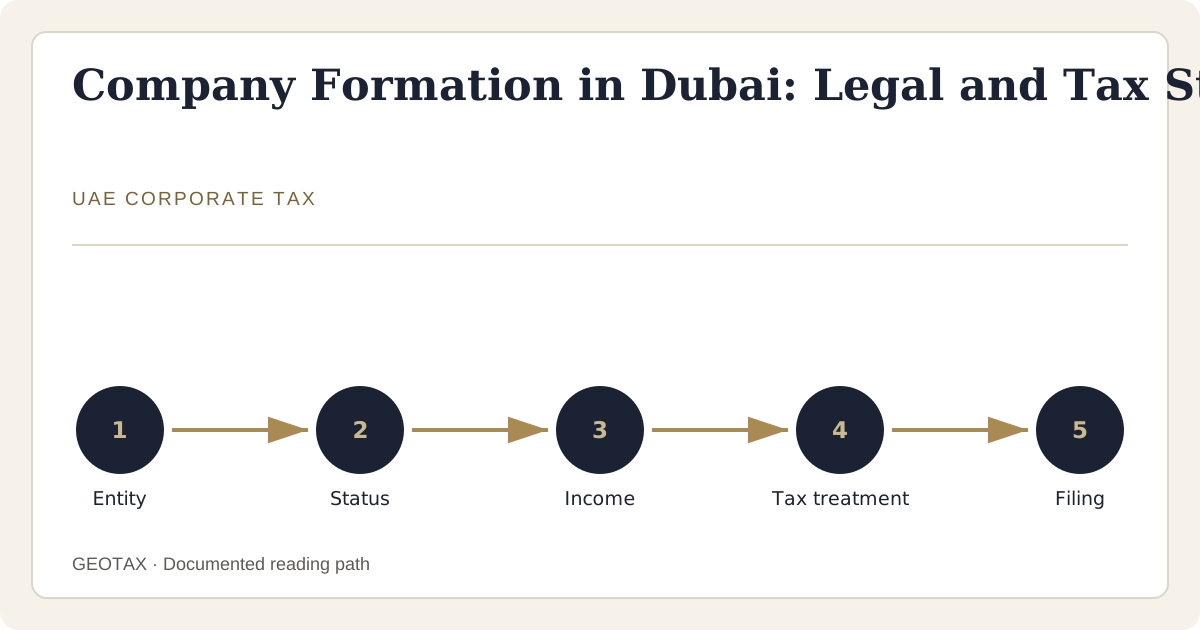
Dubai offers two incorporation regimes: Free Zone (100% foreign ownership, QFZP 0% tax, regulated activities) and Mainland (local market access, DED license, 9% Corporate Tax). Since Executive Council Resolution No. 11/2025, dual licensing allows combining both regimes. The optimal choice depends on your activity type, target market, and overall tax strategy.
Free Zone vs Mainland — Comparative Analysis
The Free Zone Company
A Free Zone is a demarcated geographical area in the UAE where the legal and tax regime deviates from mainland rules. Companies operating in Free Zones enjoy substantial advantages:
- 100% Foreign Ownership: Foreign investors can hold 100% equity without mandatory Emirati partners.
- QFZP Tax Benefit: Access to Qualified Free Zone Person status offering 0% tax on qualifying income (see Corporate Tax UAE).
- Operational Autonomy: Freedom to import/export goods and manage inventory without internal customs restrictions.
- Geographic Restrictions: Commercial activities limited to the Free Zone perimeter. Local market sales generally require a local distributor, a Mainland branch or a dual licensing arrangement; for tax purposes, such Mainland revenue is non-qualifying and capped by the de minimis rule (5% of revenue or AED 5m, Cabinet Decision No. 100 of 2023).
- Licensing Costs: Higher annual fees than Mainland (5,000-15,000 AED depending on activity and Free Zone).
The Mainland Company
A Mainland entity operates in the continental zones of Dubai and the UAE under the general Emirati regime:
- Direct Local Commerce: Unlimited access to the UAE market with direct client invoicing.
- 100% Foreign Ownership: Federal Decree-Law No. 26 of 2020, amending the Commercial Companies Law and effective 1 June 2021, allows 100% foreign ownership for most Mainland activities, without a local sponsor.
- Mainland Tax Regime: 9% Corporate Tax on taxable income exceeding AED 375,000 (Cabinet Decision No. 116 of 2022), without access to the Free Zone 0% regime.
- Geographic Flexibility: Activities unrestricted; possibility of virtual or shared office space.
- Lower Licensing Fees: Reduced annual costs (3,000-8,000 AED depending on activity, indicative).
- Strategic Impact Activities: By exception, certain activities (defense, security, certain banking, insurance or telecommunications activities) remain subject to Emirati participation or approval requirements (Cabinet Resolution No. 55 of 2021 on strategic impact activities).
| Criteria | Free Zone | Mainland |
|---|---|---|
| Foreign Ownership | 100% possible | 100% for most activities (FDL 26/2020); restrictions for strategic activities |
| Local Market Access | Restricted, 0-10% revenue | Unlimited |
| Tax Rate (QFZP/Mainland) | 0% qualifying income, 9% other | 9% (from 375k AED) |
| Annual Costs | 5,000-15,000 AED | 3,000-8,000 AED |
| Economic Substance | Mandatory (offices, staff) | Flexible (virtual office possible) |
| France-UAE Treaty | Applicable (with restrictions) | Fully applicable |
Strategic Choice: Choose Free Zone if your model focuses on export, logistics, or finance, and you don't target the local market. Choose Mainland if you serve local clients or prefer flexibility and reduced costs.
Tax Lawyer Expertise
Professional Confidentiality and Legal Security
Engaging a tax lawyer from the outset of structuring provides essential protection. Under professional privilege recognized by French and Emirati courts, advice provided and documents prepared in the attorney-client relationship cannot be disclosed to tax authorities without consent. This protection extends to articles of incorporation, strategic memoranda, and compliance analyses. This protection does not exist if you proceed alone.
Legal Security: Custom Articles of Association
The Memorandum of Association (MoA) must be drafted carefully to:
- Reflect True Intent: Define responsibilities, decision-making powers, profit distribution, and arbitration clauses.
- Anticipate Transformations: Mechanisms for share transfers, purchase options, and anti-takeover protections.
- Secure Financing: Pledge clauses, guarantees, and investor rights.
- Respect UAE Standards: Compliance with the applicable licensing, corporate, tax and accounting requirements in the relevant jurisdiction, including, where applicable, separate financial records for activities carried on outside the Free Zone and Emirati civil law.
Global Tax Vision: France and UAE
Setting up in the UAE does not erase French obligations. A tax lawyer integrating both jurisdictions ensures:
- Tax Residence: Your structure complies with Emirati tax residence criteria and does not trigger parallel French taxation.
- Tax Treaties: Proper application of the France-UAE treaty to avoid double taxation or penalties.
- French Reporting Obligations: Declaration of foreign bank accounts (FATCA, CRS), affiliation with foreign entities (Form 3916), worldwide income.
- Transfer Pricing: Documentation of intra-group transactions in line with OECD standards, avoiding French and Emirati adjustments.
Incorporation Protocol
Phase 1 — Audit and Validation
Estimated Duration: 1-2 weeks
- Business Model Definition: Detailed analysis of your activity, projected revenue, markets, and cost structure.
- Jurisdiction Selection: Free Zone vs Mainland analysis; identification of optimal Free Zone (Jebel Ali, Dubai Silicon Oasis, DAFZA, Ajman, etc.) based on activity type.
- Due Diligence: Verification of your legal capacity to operate (background, prior authorizations for regulated sectors).
- Preliminary Tax Study: Tax impact of structure choice, taxation projections, treaty applications.
- Strategy Documentation: Comprehensive memorandum outlining choices and roadmap.
Phase 2 — Licensing and Articles
Estimated Duration: 2-4 weeks
- Memorandum of Association (MoA) Drafting: Custom articles compliant with Emirati civil law, tailored to your structure (LLC, JSC, partnership).
- Commercial Name Reservation: Availability verification with the registry (Free Zone authority, or the Department of Economy and Tourism — DET, formerly DED — for Mainland Dubai).
- License Application: Submission of incorporation documents with owner identification, bank attestations, reference letters, background checks.
- Administrative Approval: Issuance of Certificate of Incorporation and business license.
- Local Registration Number: Assignment of the registration number by the Free Zone authority or the DET.
Phase 3 — Residency and Banking
Estimated Duration: 2-4 weeks
- Residence Visa: Application for a resident visa for shareholders/directors with the GDRFA (General Directorate of Residency and Foreigners Affairs) in Dubai or the federal ICP. Biometric file creation.
- Medical Examination: Mandatory medical screening at approved clinic (HIV, TB testing, etc.).
- Emirates ID: Registration with the ICP (Federal Authority for Identity, Citizenship, Customs & Port Security) for Emirates ID card issuance.
- Bank Account Opening: Presentation to bank (FAB, ADIB, DIB, Mashreq, etc.) with finalized documents. Signing authority setup.
- FTA Registration: Corporate Tax registration with the Federal Tax Authority within the deadlines of FTA Decision No. 3 of 2024 (3 months from incorporation for new entities).
- Tax Residency Certificate (TRC): Certificate of tax residency issued by FTA, essential for French tax treatment.
Dual Licensing (2025 Innovation)
Executive Council Resolution No. 11/2025 Dubai
In 2025, Dubai introduced the ability to hold simultaneous Free Zone and Mainland licenses under a single entity structure. This dual licensing model opens new operational strategies:
Operational Advantages
Dual licensing should not be presented as a simple juxtaposition of Free Zone and Mainland activities. Where a Free Zone entity carries on activities outside the Free Zone in the Emirate of Dubai, it must comply with the framework set by Executive Council Resolution No. 11 of 2025, including obtaining the appropriate title and maintaining separate financial records for activities carried on outside the Free Zone.
- Market Scope Expansion: Unlimited local market access (Mainland) combined with export benefits (Free Zone).
- Tax Optimization: Segregation of qualifying and non-qualifying income; strategic allocation to 0% vs 9% regimes.
- Reduced Administrative Complexity: Single entity with dual operational licenses eliminates separate company management.
Compliance Considerations
Dual licensing requires careful accounting separation to justify the dual regime benefit claim. Transfer pricing documentation between Free Zone and Mainland operations must comply with OECD guidelines. France-UAE treaty application becomes complex; advance ruling from FTA recommended.
Key Takeaway
Dual licensing is ideal if you combine export (Free Zone) and local services (Mainland), but demands rigorous documentation and professional tax management. Improper application risks penalty assessments and loss of 0% benefits.
Need expert guidance?
Let's discuss your situation
Free 10-minute initial call. Jonathan Sémon responds personally.
Book a consultationFrequently Asked Questions
References
- Federal Decree-Law No. 26 of 2020 (100% foreign ownership, amending the Commercial Companies Law) — UAE Legislation
- Federal Decree-Law No. 32 of 2021 (Commercial Companies Law) — UAE Legislation
- Federal Decree-Law No. 47 of 2022 (Corporate Tax Law) and Cabinet Decision No. 116 of 2022 — Federal Tax Authority
- Cabinet Decision No. 100 of 2023 (Qualifying Income) and Ministerial Decision No. 229 of 2025 (Qualifying Activities) — UAE Legislation
- FTA Decision No. 3 of 2024 (registration deadlines) — Federal Tax Authority
- Cabinet Decision No. 85 of 2022 (UAE tax residency) — Federal Tax Authority
- Executive Council Resolution No. 11 of 2025 (free zone companies operating outside free zones in Dubai) — Dubai Legislation Portal
Ready to Launch Your Dubai Company?
Let our tax lawyers guide your incorporation with a custom strategy that optimizes your legal and tax position. From structure selection to banking, we handle every detail.