The French impatriate regime: preparing the tax side of your return to France
Article 155 B of the French Tax Code (CGI) grants employees and executives who settle in France after at least five years of non-residence a temporary exemption regime: an impatriation bonus exempt from income tax, an exemption for the portion of remuneration relating to duties performed abroad, a 50% exemption on foreign-source dividends, capital gains on securities and certain intellectual property income, and a real estate wealth tax (IFI) limited to French property only for five years. The regime applies until 31 December of the eighth year following the start of duties — but it is set up before the contract is signed, not after the move. For an executive returning from Dubai or Singapore, it is the exact mirror image of the exit tax: the « return corridor ».
Key points
The impatriate regime depends on recruitment, prior residence and the conditions of residence in France. The bonus, other income and period of application must be assessed separately; an unknown essential condition prevents a conclusion on eligibility.
Page references: Article 155 B du CGI · article 80 ter du CGI
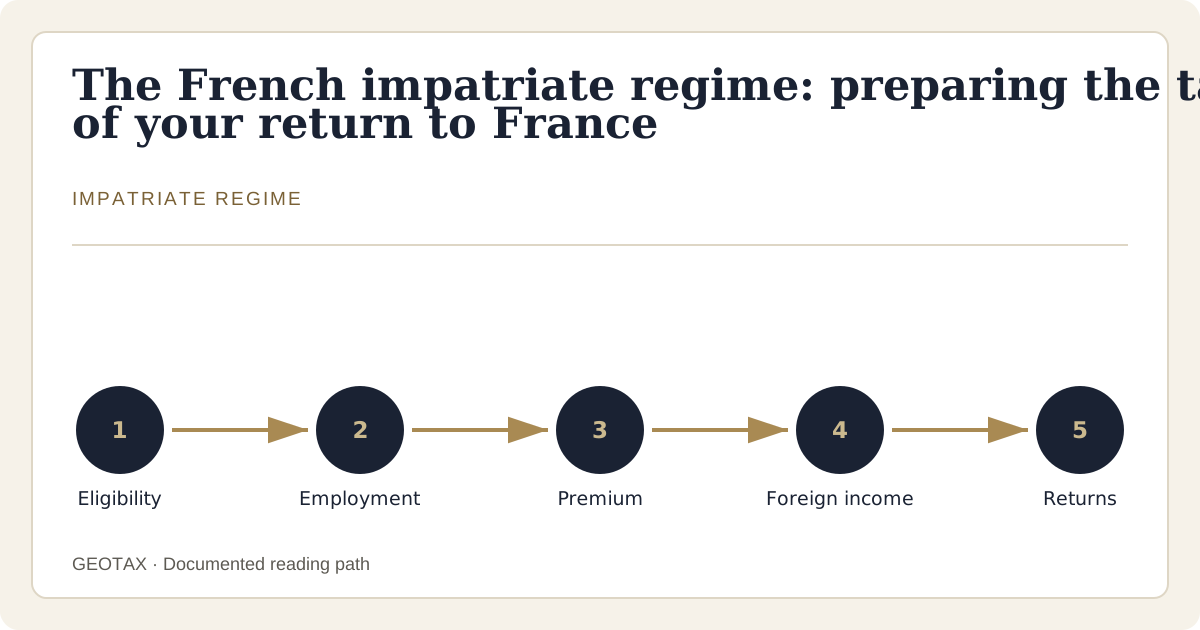
The impatriate regime benefits employees and certain executives (1°, 2° and 3° of b of article 80 ter of the CGI) called from abroad to take up a position in a company established in France — intra-group mobility or direct external recruitment — provided they were not French tax residents during the five calendar years preceding the start of duties and become tax-domiciled in France (art. 4 B, 1-a and b of the CGI) from that date. It exempts from income tax the impatriation bonus (actual amount set in the contract before the start of duties or, by election, a flat 30% of net remuneration) and the portion of remuneration relating to work performed abroad, subject to a dual cap at the taxpayer's choice (50% of total remuneration, or the « foreign » portion capped at 20%). It also exempts 50% of foreign-source investment income, capital gains on disposals of securities and certain intellectual property income (where the source State is bound to France by an exchange-of-information clause — which is the case of the United Arab Emirates). Duration: until 31 December of the 8th calendar year following the start of duties (since 6 July 2016). A return from expatriation organized with the employer is expressly accepted by the administrative guidance (BOI-RSA-GEO-40-10-10, § 40, 11 August 2025).
Impatriate Regime silo — contents
This pillar page gives an overview. For each topic, a dedicated page goes deeper into the conditions, the legal texts and best practice.
Product · Turnkey note
Get the impatriate HR note, ready to hand to your employer
Bilingual FR/EN note (~20 pp.): regime, model clause, payroll/DSN, filing checklist, English HR FAQ. Note only €1,500 · Note + video pack €2,000. Instant PDF delivery.
Get the HR note →How article 155 B of the CGI works
The impatriate regime is the inbound counterpart of the rules that govern departures (the exit tax of article 167 bis of the CGI). Introduced by article 121 of the law of 4 August 2008 on the modernization of the economy, it is designed to attract to France — or bring back — executives, managers and talent based abroad, by temporarily neutralizing part of the additional tax cost of settling in France.
The principle: over a period running until 31 December of the eighth calendar year following the start of duties, certain items of income escape income tax, in whole or in part. The regime applies as of right, without prior approval: there is no application to file with the tax authority. But it is not presumed — it takes form in the employment contract, in payroll, then in the income tax return.
The three pillars of the exemption
- Employment income: the impatriation bonus (actual amount or a flat 30%) and the portion of remuneration relating to workdays abroad are exempt from income tax, subject to a dual cap at the taxpayer's choice (50% overall or 20% on the « foreign » portion). See the impatriation bonus page.
- Foreign-source passive income: dividends, interest, capital gains on disposals of securities and certain intellectual property income received abroad are exempt up to 50%, where the payer or custodian is established in a State bound to France by an exchange-of-information clause. See the exemptions page.
- Wealth: the real estate wealth tax (IFI) applies only to real property and property rights located in France until 31 December of the fifth year following the move (art. 964, 1° of the CGI) — this component benefits any new resident after five years of non-residence, with no employment requirement.
The income-tax exemption under Article 155 B does not halve the social-levy base for the relevant investment income. The rate depends on the product and period: 18.6% for the affected 2026 categories, while 17.2% continues to apply to certain life-insurance and capitalisation products. Check the contract category and DGFiP exceptions; the impatriate regime does not impose one uniform social-levy rate on all investment income.
Who is the regime for?
Two groups are covered, under the same condition of not having been a French tax resident during the five calendar years preceding the start of duties:
1. Employees and executives on intra-group mobility
Persons employed by a foreign entity and called to work in a company established in France that is related to the home company (capital, legal or commercial links). This is the channel of the return from expatriation organized with the employer: the administrative guidance expressly accepts that expatriates who return to the French company that employed them before their departure — or to another group company — qualify for the regime, even if their French contract was terminated, suspended or amended during the expatriation (BOI-RSA-GEO-40-10-10, § 40, version of 11 August 2025).
2. Persons recruited directly from abroad
Persons recruited from abroad by a company established in France, whether they were employed by another employer, self-employed or not working. Since the guidance update of 11 August 2025, persons who apply from abroad for a job in France are expressly treated as recruited directly from abroad. Conversely, those who come to France on their own initiative before being recruited, or who have already established their home there at the time of recruitment, are excluded.
Eligible persons are employees and executives treated as employees for tax purposes (1°, 2° and 3° of b of art. 80 ter of the CGI: chairman of the board, chief executive officer, deputy chief executive officers, management board members of SA/SAS companies, minority or equal-share managers of SARL companies, executives subject to the tax regime of employees). The liberal professions and the self-employed are not — the « non-salaried » component of the regime was repealed from 2017. Full detail on the eligibility conditions page.
What the regime delivers: orders of magnitude
The benefit depends on the level of remuneration, the structure of the package and the assets kept abroad. By way of illustration, and without any commitment:
| Item | Without the regime | With the 155 B regime (illustration) |
|---|---|---|
| Net remuneration of €200,000 including a €50,000 impatriation bonus | €200,000 taxable | €150,000 taxable (bonus exempt, subject to the reference remuneration and the caps) |
| 30 days of assignments abroad per year | Taxable | Corresponding fraction exempt, within the chosen cap (50% overall or 20%) |
| Dividends from a portfolio kept in Dubai: €40,000 | The income-tax exemption under Article 155 B does not halve the social-levy base for the relevant investment income. The rate depends on the product and period: 18.6% for the affected 2026 categories, while 17.2% continues to apply to certain life-insurance and capitalisation products. Check the contract category and DGFiP exceptions; the impatriate regime does not impose one uniform social-levy rate on all investment income. | Income tax (12.8%) computed on €20,000; social levies on €40,000 |
| IFI — real estate kept abroad | Worldwide real estate taxable | Only French property is taxable, until 31 December of the 5th year (art. 964 CGI) |
Each line assumes specific conditions are met (reference remuneration, source State covered by an exchange-of-information clause, caps). No saving is guaranteed: only an individualized analysis of the package and the assets can quantify the actual benefit.
How to activate the regime — timing is everything
- Before signing: verify the five years of non-residence, negotiate the impatriation bonus and have it stated separately in the contract or an addendum drawn up before the start of duties (BOI-RSA-GEO-40-10-20, § 60), and document the recruitment or transfer from abroad.
- On taking up duties: transfer your tax domicile to France (home or main place of stay + main occupation, art. 4 B, 1-a and b). An administrative tolerance allows the household to settle in France up to the end of the calendar year following the start of duties without losing the salary exemption.
- In payroll: the employer reports separately, in the DSN payroll filing, the taxable salaries and the amounts exempt under the regime; the exempt bonus is outside the basis of French withholding at source.
- Each year: exercise the elections (30% flat-rate option, choice of cap) by express statement on the tax return, report the taxable salary in boxes 1AJ/1BJ and the exempt amounts in boxes 1DY/1EY of form 2042 C, and report foreign income (form 2047) and accounts held abroad (forms 3916/3916 bis). Detail on the tax returns page.
Legal certainty. The tax authority encourages the use of advance rulings (rescrit — LPF, art. L. 80 A and L. 80 B) to lock in, before the return, the position on eligibility or on the reference remuneration. Persons still abroad can contact the DGFiP's Tax4Business desk. GEOTAX prepares these requests as part of its engagements.
An 8-year window — neither extendable nor retroactive
For duties taken up since 6 July 2016, the exemptions apply until 31 December of the eighth calendar year following that of the start of duties (five years for earlier start dates). The regime is preserved in the event of a change of position within the company or mobility to another company of the same group (control within the meaning of article L. 233-3 of the French Commercial Code), but the period continues to run from the first start of duties. Leaving the host company for an employer outside the group, or losing French tax domicile, forfeits the benefit for the year concerned. See the 8-year period page.
The GEOTAX case: returning from Dubai
For an executive or company officer based in the Emirates for at least five calendar years, the return to France can be structured around the impatriate regime: negotiating the package before signing, qualifying the move as intra-group mobility or external recruitment, handling income from the portfolio kept in the UAE (the Emirates are bound to France by the treaty of 19 July 1989, which contains an exchange-of-information clause: UAE-source passive income qualifies for the 50% exemption), switching tax residence and coordinating with any exit tax deferral obtained on leaving France. We have devoted a full page to this journey: returning from Dubai under the impatriate regime.
Official sources
References current as of 11 June 2026. Applying them to any specific situation requires individualized analysis.
Statutes
- Article 155 B du CGI (impatriate regime, wording as amended by the 2019 Finance Act — Légifrance, in French); article 80 ter du CGI (executives treated as employees — in French); article 964 du CGI (IFI for new residents — in French).
- Article 6 de la loi n° 2018-1317 du 28 décembre 2018 (extension of the 30% flat-rate option — Légifrance, in French).
Administrative guidance
- BOI-RSA-GEO-40-10 (overview and duration); BOI-RSA-GEO-40-10-10 (scope, version of 11 August 2025); BOI-RSA-GEO-40-10-20 (remuneration, version of 11 August 2025); BOI-RSA-GEO-40-10-30 (passive income and capital gains) — all in French.
- impots.gouv.fr — Le régime des impatriés (official DGFiP fact sheet, in French).
Frequently asked questions
Prepare your return before you sign
Eligibility, bonus negotiation, package structuring, residence switch and first tax return: GEOTAX secures every step of the return corridor. Video consultation: AED 2,000 (approx. €470). In person at our Dubai office: AED 2,500 (approx. €590).
The impatriate HR note: turnkey PDF (FR/EN)
A bilingual ~20-page note to hand to your employer: the regime, a model clause, payroll/DSN, a filing checklist, an English HR FAQ. Note only €1,500 · Note + video pack €2,000.
Get the HR note →Tax sources and review date
Fiscal review: 5 September 2026. The applicable text and tax period must be checked for each situation.