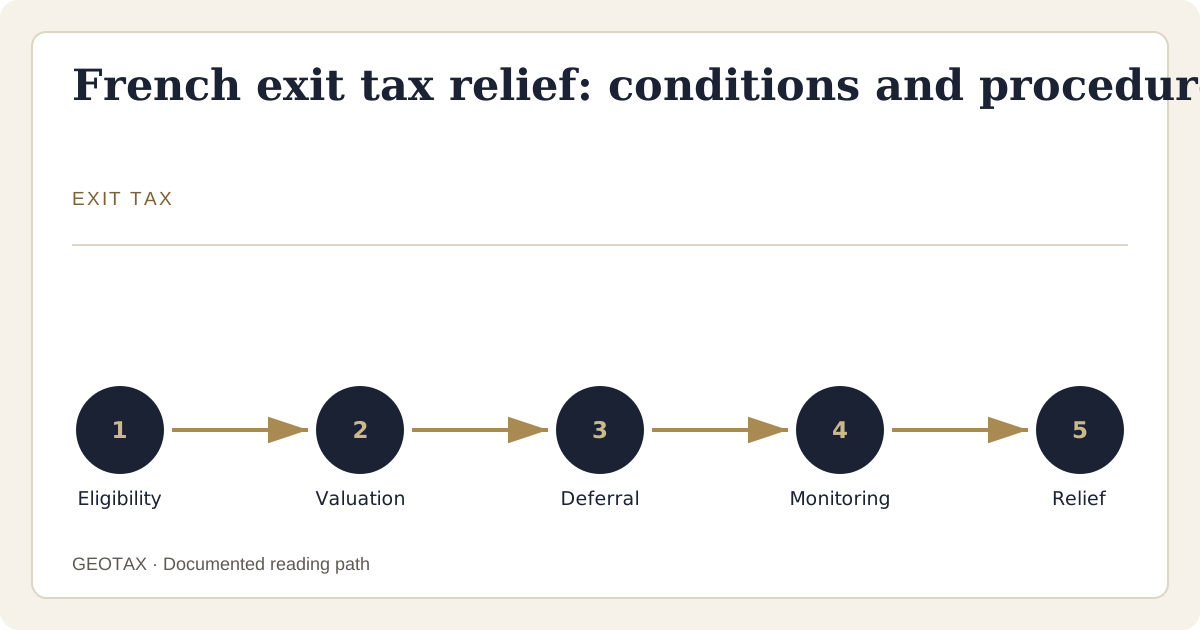
French exit tax relief: conditions and procedure
Holding periods, cumulative conditions, application procedure, automatic relief on early return to France, and how relief interacts with a subsequent sale of the securities.
Relief: the end goal of the deferral
Exit tax relief is the event by which the tax claim is extinguished permanently, with no payment owed by the taxpayer. The deferral is only an intermediate mechanism: relief is its natural outcome, provided no forfeiture event has occurred in the meantime.
Holding periods: 2 years or 5 years depending on portfolio value
Paragraph VII of Article 167 bis of the French Tax Code (CGI) sets, for transfers occurring since 1 January 2019, two different periods based on the value of the securities held at the transfer date:
| Portfolio value at transfer | Holding period | Relief |
|---|---|---|
| Below EUR 2.57M | 2 years from transfer | Automatic (income tax and social levies) |
| Exactly EUR 2.57M | Confirmation required | The CGI says “exceeds” for five years; the 2026 Form 2074-ETS3 uses ≥ |
| Above EUR 2.57M | 5 years from transfer | Automatic (income tax and social levies) |
The figure used is the aggregate value of the securities falling within the scope of the exit tax on the transfer date, as reported on Form 2074-ETD. For reference, the period is 15 years for transfers made from 2014 to 2018 and 8 years for those made from 2011 to 2013.
Cumulative conditions for relief
- The taxpayer has retained the securities throughout the required period without selling, gifting, redeeming, or contributing them;
- No forfeiture event has occurred during the deferral period;
- The taxpayer has complied with the reporting obligations (Form 2074-ETD, then Form 2074-ETS where an event occurs);
- Relief is granted automatically by law (Article 167 bis, VII of the CGI), but in practice requires the filing of the follow-up return reporting the event (box 430 of Form 2074-ETS3) together with the supporting evidence.
Application procedure
- At the end of the period (2 or 5 years), the taxpayer completes the "expiry of the period" box of follow-up Form 2074-ETS3, filed with returns 2042 and 2042 C with the non-residents' tax office in the year following the event.
- The file includes: evidence of continued ownership of the securities, a copy of the assessment notices issued for the year of transfer and, where applicable, a certificate from the fiscal representative (paragraph V) and proof of foreign tax residence.
- The tax authorities review the application and notify their decision to the fiscal representative (paragraph V) or directly to the taxpayer (paragraph IV).
- If granted, the exit tax is relieved and the guarantees are released.
- In the event of partial or full refusal, a hierarchical appeal followed by litigation before the courts is available within the statutory deadlines.
Special case: return to France before the period ends
If the taxpayer transfers his tax residence back to France before the 2 or 5 year period ends, and has retained the securities, the exit tax is automatically relieved, with no minimum holding requirement. This rule, set out in paragraph VII of Article 167 bis of the CGI, follows from the fact that the return removes the triggering event of the transfer; tax-deferral regimes terminated by the departure are reinstated by operation of law.
The procedure in this scenario involves notifying the tax authorities of the return to France, terminating the fiscal representative's mandate, and requesting release of the guarantees.
Special case: death of the taxpayer
The death of the expatriate taxpayer triggers relief (or a refund where the tax had been paid) of the exit tax on unrealised gains and earn-out claims, provided the securities are still in the deceased's estate at the date of death (Article 167 bis, VII of the CGI). Heirs or successors complete the "death of the taxpayer" box of the follow-up return (box 460 of Form 2074-ETS3). Certain gains placed in deferral under former regimes become due upon death, by contrast.
Interaction with a subsequent sale
An actual sale of the securities after relief is governed by the standard capital gains regime of the taxpayer's country of residence on the sale date. For a UAE resident, the absence of personal income tax in the UAE means the gain is not taxable in Dubai. France generally has no taxing right over the gain, subject to specific exceptions (such as securities of predominantly French real-estate companies, or substantial participations within Article 244 bis B of the CGI, subject to treaty provisions).
Relief converts the exit tax from a potential tax charge into a simple holding requirement of 2 or 5 years. For a founder who has no intention of selling promptly, that requirement is not punishing. For a founder anticipating a near-term sale (investor exit, IPO, M&A transaction), it may be preferable to complete the sale before departure and crystallize the gain under the French regime, rather than placing the transaction under deferral.
Personalized Exit Tax Audit
A one-hour videoconference to review your situation, calibrate your exit tax exposure and secure your transfer to Dubai. Fee: AED 2,000 (approx. EUR 470).
Book an auditSources & case law
References current as at the date of last revision, cited for information only. Any application to a particular situation requires an individualised analysis.
Legislation
- Article 167 bis CGI (exit tax, transfers since 3 March 2011); Article 238-0 A CGI (non-cooperative States list); Article 41 tervicies E of Annex III to the CGI.
- Décret n° 2019-868 of 21 August 2019 (on-election deferral, proposal of guarantees).
Administrative doctrine (BOFiP)
- BOI-RPPM-PVBMI-50 (exit tax); -50-10-30 (deferral); -50-10-40 (relief); -50-10-50 (reporting obligations, Forms 2074-ETD / 2074-ETS). (historical archived guidance; cross-check against the CGI, implementing rules and current 2026 forms/notices)
Case law
- CE, 9th–10th Ch., 15 December 2025, No. 495783 — the deferral suspends the limitation period for recovery; a reporting failure restores immediate enforceability only after an unanswered formal notice to regularise.
- CE, 5 February 2025, No. 476399 — limits on the retroactivity of the exit tax under EU law.
- ECJ, 11 March 2004, de Lasteyrie du Saillant, C-9/02; CE, 10 November 2004, No. 211341; CE, 29 April 2013, No. 357576; CE, 20 May 2022, No. 449038.
Key points
Holding periods, cumulative conditions, application procedure, automatic relief on early return to France, and how relief interacts with a subsequent sale of the securities.
Page references: 167 bis CGI · Décret n° 2019-868 of 21 August 2019