Returning from Dubai: the tax journey back to France
Key answer
The income-tax exemption under Article 155 B does not halve the social-levy base for the relevant investment income. The rate depends on the product and period: 18.6% for the affected 2026 categories, while 17.2% continues to apply to certain life-insurance and capitalisation products. Check the contract category and DGFiP exceptions; the impatriate regime does not impose one uniform social-levy rate on all investment income.
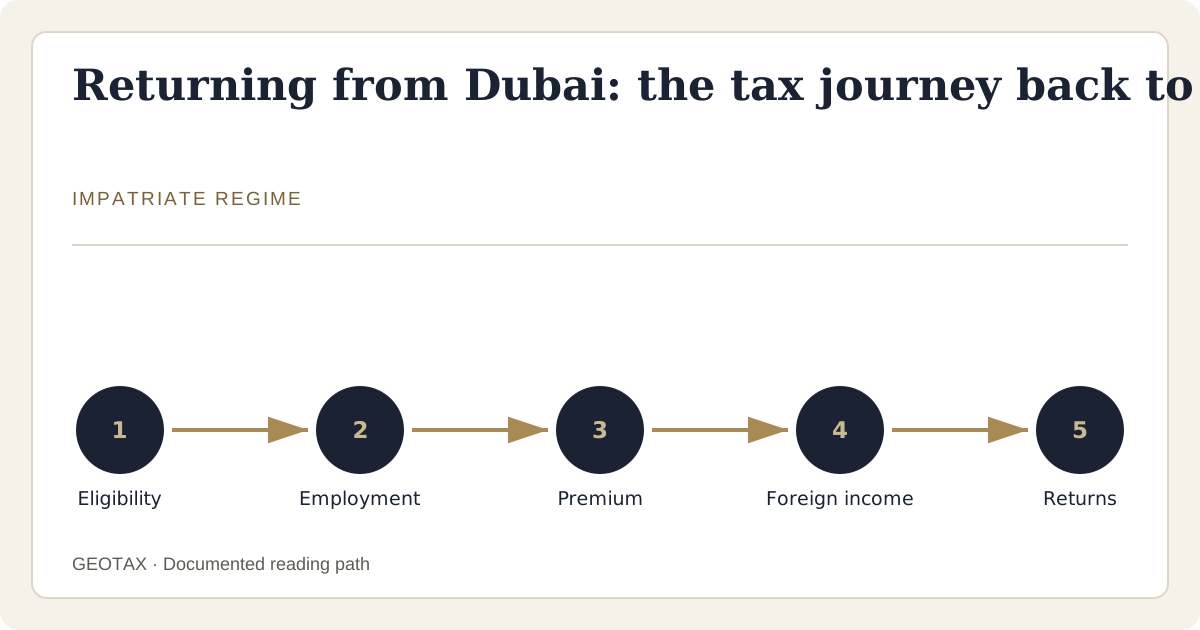
After five years or more in the Emirates, the return to France can be organized around the impatriate regime: package negotiated before signing, UAE portfolio 50% exempt, IFI limited to French property — and, for those holding an exit tax deferral, a relief at the end. The GEOTAX playbook.
The typical scenario
An executive or company officer settled in the Emirates in 2019 or 2020 — often assisted by GEOTAX on the way out, with a carefully built exit tax file and UAE tax residence. Six years later, the group offers them a position in Paris, or a French company recruits them. The question is no longer « how to leave » but « how to return » — and the return, like the departure, is decided before signing.
Properly prepared, this return combines: the impatriate regime (art. 155 B of the CGI) on salaries and financial assets, the IFI limited to French property for five years, and — for those who left France with an exit tax deferral — the relief of the tax under deferral.
Are you eligible? The five-UAE-years test
First condition: not having been a French tax resident during the five calendar years preceding the year duties begin. An actual departure in mid-2020 thus allows an eligible start of duties from January 2026. The evidence built up in the Emirates now takes on its full value: annual Tax Residency Certificates (TRC), residence visa, leases, Ejari records, DEWA bills, entry-exit stamps. The same documentary logic that protected against a residence reclassification now serves to prove eligibility for the impatriate regime.
Second condition: being recruited or transferred from Dubai, before settling in France. Two channels (detail on the eligibility page):
- Intra-group mobility: your UAE employer (group subsidiary, holding company, branch) transfers you to the French entity. The guidance expressly accepts the return to the French company that employed you before the expatriation (BOI-RSA-GEO-40-10-10, § 40, version of 11 August 2025) — including where the French contract was terminated or suspended at the time of departure;
- External recruitment: a French company recruits you while you are still domiciled in the Emirates — including after an application sent from Dubai (§ 80).
Returning first, looking for a job afterwards: that scenario excludes the regime — the person came on their own initiative or was already domiciled in France at the time of recruitment. If the family return is pressing (start of the school year), the household settling-in tolerance (until the end of the year following the start of duties) offers some leeway: the employee can take up duties after their family, as long as the contract was concluded while they were still domiciled in the UAE and the timeline is documented. A set-up to handle with caution, with evidence to back it up.
The 1989 treaty and the residence switch
France and the Emirates are bound by the tax treaty of 19 July 1989 (supplemented by the 1993 protocol). For the return, three contributions:
- Salaries (article 13): as long as you are a UAE resident working there, your UAE salaries are not taxable in France; after the switch, your French salaries fall under ordinary French rules — framed, where applicable, by the impatriate regime;
- Residence switch: the year of return is split — non-resident until the move (taxable in France on French-source income only), resident afterwards (worldwide income). The exact switch date (start of duties, arrival of the household) must be consistent across both files;
- Exchange-of-information clause: it places the UAE on the list of States covered for the application of article 155 B, II (BOI-ANNX-000508, version of 8 October 2025: « yes » for income tax). It is this clause that opens the 50% exemption on income from the UAE portfolio.
The portfolio kept in the UAE: the 50% exemption
The income-tax exemption under Article 155 B does not halve the social-levy base for the relevant investment income. The rate depends on the product and period: 18.6% for the affected 2026 categories, while 17.2% continues to apply to certain life-insurance and capitalisation products. Check the contract category and DGFiP exceptions; the impatriate regime does not impose one uniform social-levy rate on all investment income.
Structuring decisions to take before the return:
- Keep the securities account in the UAE (or in another covered State): repatriating the securities to a French custodian would forfeit the 50% exemption on capital gains; merely repatriating the cash after receipt abroad is, by contrast, without consequence (BOI-RSA-GEO-40-10-30-10, § 100);
- Time the disposals: selling before the return (as a non-resident) or during the impatriation period (50% exemption) does not cost the same — each situation should be quantified;
- Inventory non-eligible products: crypto-assets (excluded from the exemption — Rép. min. Senate, 4 December 2025, no. 2483), rental real estate, interposed structures to review (art. 123 bis where applicable).
All bank accounts, securities accounts and insurance or capitalization policies held in the UAE must be reported with the first French income tax return (forms 3916/3916 bis; CGI, art. 1649 A and 1649 AA). The fine is €1,500 per undeclared account, and the omission is in practice inconsistent with the claimed benefit of the 50% exemption — which presupposes precisely assets held abroad. Transparency is the best strategy here.
Had an exit tax deferral? The return unwinds it
For those who left France after 2011 with latent capital gains placed under the exit tax regime (elective deferral under V of article 167 bis, guarantees, fiscal representative), the return to France is a favorable event: for securities still in the estate, the tax under deferral is relieved — or refunded if it had been paid — and the guarantees can be released (CGI, art. 167 bis, VII; see our relief page).
Points of vigilance: report the event (the return) in the exit tax follow-up, request the release of the guarantees, and check the consistency of dates between the end of UAE residence, the French start of duties and the 2074-ETS file. A poorly documented return can delay the relief by several months.
Negotiating the package before signing
The return is negotiated like the departure: before. Beyond the salary, the tax parameters of the package are:
- the impatriation bonus, quantified or determinable, in the contract or addendum signed before the start of duties (failing that, the 30% flat rate remains available — see the bonus page);
- the start-of-duties date: it governs both the five-year test (calendar years) and the end of the regime (starting early in the year maximizes the duration — see the 8-year period page);
- the workdays abroad: for a role with a regional dimension (Middle East, Africa), the portion of remuneration relating to assignments outside France can be exempted — to be organized contractually;
- the reference remuneration: ask the employer to document it from hiring;
- the contributions: treatment of international pension plans subscribed in the UAE (deductibility to review, art. 83 of the CGI) and the possible old-age affiliation exemption (CSS, art. L. 767-2).
The GEOTAX return timeline (12 months)
| Milestone | Action |
|---|---|
| D-12 to D-6 months | Eligibility audit (5 years, recruitment channel); package simulation; review of the UAE portfolio and the exit tax file |
| D-6 to D-3 months | Negotiation and signature of the contract/addendum with the bonus clause, from Dubai; choice of the start-of-duties date; portfolio structuring (custodian, reallocations) |
| D-3 months to D | Organizing the move and the residence switch; documented account closures or retentions; informing the employer (DSN, reference remuneration) |
| D to D+6 months | Start of duties; settling the household; notifying the return in the exit tax file and requesting the release of the guarantees |
| Spring Y+1 | First tax return: 155 B elections, 1AJ/1DY, 2047, 2074-IMP, 3916/3916 bis (see the tax returns page) |
Prepare your return with the firm that handled your departure
From Dubai, GEOTAX advises French expatriates in the Emirates — on the way out and on the way back. Eligibility audit, package and portfolio structuring, exit tax coordination: video consultation, AED 2,000 (approx. €470), or at our Dubai office, AED 2,500 (approx. €590).
Book a consultationOfficial sources
References current as of 11 June 2026. Applying them to any specific situation requires individualized analysis.
Statutes
- Article 155 B du CGI (Légifrance, in French); article 167 bis du CGI (exit tax, VII: relief — in French); article 964 du CGI (IFI — in French); articles 1649 A and 1649 AA of the CGI (foreign accounts).
- France-United Arab Emirates tax treaty of 19 July 1989, supplemented by the protocol of 6 December 1993 (see our detailed analysis).
Administrative guidance
- BOI-RSA-GEO-40-10-10 (return from expatriation § 40, application from abroad § 80, version of 11 August 2025 — in French).
- BOI-RSA-GEO-40-10-30-10 (income received abroad § 100); BOI-ANNX-000508 (United Arab Emirates: exchange-of-information clause for income tax, version of 8 October 2025) — in French.
- impots.gouv.fr — Le régime des impatriés (return from expatriation, IFI, updated 8 April 2026 — in French).
The impatriate HR note: turnkey PDF (FR/EN)
A bilingual ~20-page note to hand to your employer: the regime, a model clause, payroll/DSN, a filing checklist, an English HR FAQ. Note only €1,500 · Note + video pack €2,000.
Get the HR note →Tax sources and review date
Fiscal review: 5 September 2026. The applicable text and tax period must be checked for each situation.