Expertise Exit tax (167 bis CGI) UAE tax residence Corporate Tax UAE France-UAE tax treaty Company formation Tax expatriation French impatriate regime
Tools Impatriate HR note (PDF) Exit tax simulator UAE residence test 12-month checklist (PDF) Free zone comparator Impatriate eligibility test
Insights All articles Universal tax (CF380) Exit tax 2026 Press
The firm About Consultation & fees Press Contact
Book a consultation

FAQ — French impatriate regime (art. 155 B CGI)
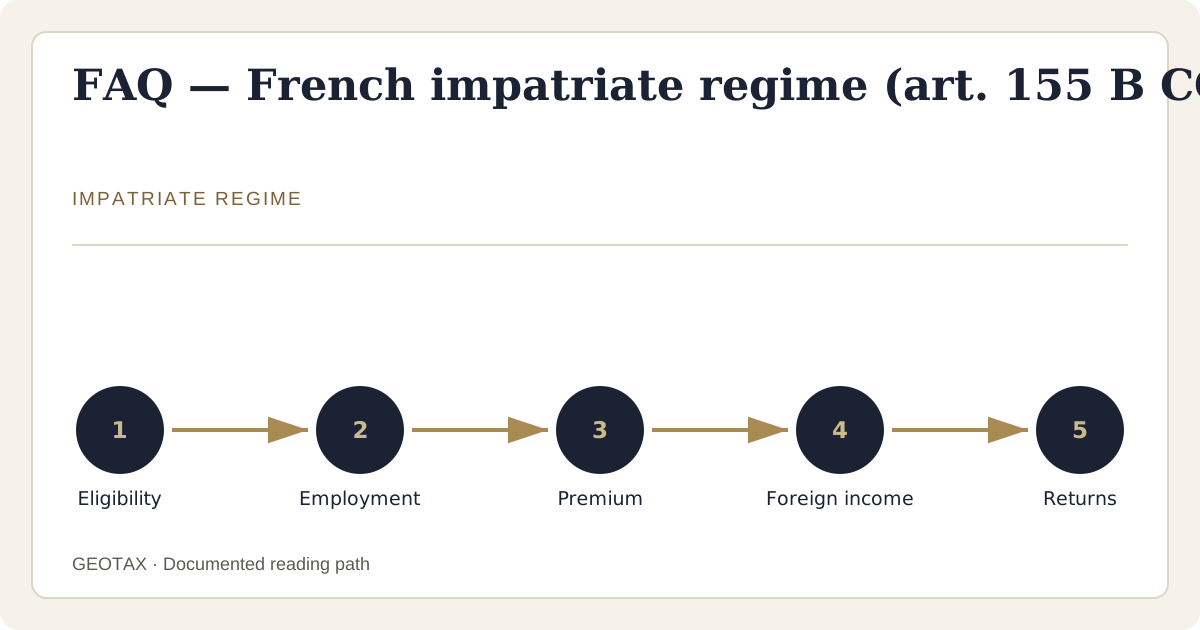
Sixteen short answers to the questions executives and company officers preparing a return to France actually ask: eligibility, duration, bonus, HR, civil servants, liberal professions, foreign income, IFI.

Impatriate Regime Silo Overview Eligibility Bonus Exemptions 8-Year Period Employer & HR Tax Returns Returning from Dubai Mistakes Test FAQ HR Note

Eligibility

Yes. Intra-group mobility is one of the two access channels to the regime, and the guidance expressly accepts the return from expatriation: an employee who comes back to work for the French company that employed them before their departure, or for another group company, is eligible if the other conditions are met — notably five calendar years of non-residence and a contract concluded before settling in France (BOI-RSA-GEO-40-10-10, § 40, version of 11 August 2025).
No. Nationality is irrelevant: a French national returning from Dubai, Singapore or New York after at least five calendar years of non-residence is eligible under the same conditions as a foreign executive recruited internationally.
In practice, no. First, the regime is reserved for positions held in a company established in France: employees of public administrative bodies are excluded, and the Conseil d'État has held this exclusion constitutional (CE, QPC, 20 May 2015, no. 388480, concerning hospital practitioners). Second, State employees serving abroad remain tax-domiciled in France (art. 4 B, 2 of the CGI) and therefore cannot meet the five-year non-residence condition — the VIE case is the case-law illustration.
No. The regime is reserved for employees and executives treated as employees for tax purposes (1°, 2° and 3° of b of article 80 ter of the CGI). The « non-salaried impatriates » component, which existed subject to approval for moves from 2008 to 2011, was repealed as from 1 January 2017. An independent consultant who wants the regime must therefore return under employee or deemed-salaried executive status — a structuring parameter to anticipate.
Yes: holding all or part of the company's capital, directly or indirectly, is not an obstacle, provided the person has the status of an employee or deemed-salaried executive (80 ter, b of the CGI), receives remuneration taxable as salaries and wages and remains taxed up to the reference remuneration. A majority manager of an SARL, taxed under article 62, remains excluded.
No. Although the statute refers to a position held « for a limited period », the administrative guidance accepts fixed-term and open-ended employment, and this position is binding on the tax authority (LPF, art. L. 80 A; to that effect CE, 22 December 2020, no. 427536). The official DGFiP fact sheet expressly states that the benefit of the regime is conditional neither on the contract stating an employment duration nor on a fixed-term contract.

Duration and life of the regime

Until 31 December of the eighth calendar year following that of the start of duties in France, for duties taken up since 6 July 2016 (five years before that). The regime applies for each year of tax domicile in France; the period is never extended, even on a change of position. Detail on the 8-year period page.
The regime is preserved on a change of position within the same company or mobility to another company of the same group (control within the meaning of article L. 233-3 of the French Commercial Code), without any extension of the period. A move to a company outside the group ends the regime, permanently: the new position, taken from France, cannot reopen it.
No: the regime applies as of right, without approval or prior request. It is implemented through the contract (bonus), payroll (DSN) and the income tax return (elections and dedicated boxes). To secure a specific point — eligibility, reference remuneration — an advance ruling can be requested (LPF, art. L. 80 A and L. 80 B), and persons still abroad can contact the DGFiP's Tax4Business desk.

Bonus and remuneration

Not since 2019. Article 6 of the 2019 Finance Act extended the election for the flat-rate valuation of the bonus (30% of net remuneration) to employees and executives called by a foreign company (intra-group mobility), for remuneration due from 1 January 2019 to persons who took up their duties on or after 16 November 2018 (BOI-RSA-GEO-40-10-20, § 102). For earlier start dates, the election remained reserved for direct external recruitment.
Yes. The exemption (bonus and foreign portion) is computed on remuneration net of social security contributions, before the 10% standard deduction or the deduction of actual expenses; the 10% or actual-expenses deduction then applies to the remuneration that remains taxable. By contrast, the regime cannot be combined with the regime for employees seconded abroad (art. 81 A, II): an irrevocable choice must be made between the two (BOI-RSA-GEO-40-10-20, § 270).
Two approaches. First, education: the bonus does not increase the employer's cost — it structures the package differently — and an employer liable to payroll tax even gains an exemption (art. 231 bis Q of the CGI); a bilingual explanatory document, like our HR note, unblocks most situations. Second, the safety net: in the absence of a contractual bonus, the election for the 30% flat-rate valuation remains available for duties taken up since 16 November 2018, on your tax return alone, without the employer's agreement.

Wealth and levies

For the duration of the regime, dividends, interest and certain intellectual property income paid by a person established outside France in a State bound to France by an exchange-of-information clause, as well as capital gains on disposals of securities held with a custodian established in such a State, are subject to income tax on only 50% of their amount. Capital losses are symmetrically taken into account at 50%. The United Arab Emirates are on the list of covered States (BOI-ANNX-000508). Detail on the exemptions page.
No. Social levies on investment income (18.6% since the 2026 social security financing law) are due on passive income and capital gains for their full amount, before the 50% exemption. On the salary side, social security contributions apply normally — with, however, a possible exemption from affiliation to the compulsory old-age insurance schemes for impatriates (CSS, art. L. 767-2) and the deductibility of certain contributions paid to foreign schemes (CGI, art. 83).
Not for their own income: the 50% exemption on passive income applies only to the income and gains of the person who meets the conditions of the regime; on a joint account, it applies up to their share (half between spouses). By contrast, the IFI component (taxation limited to French property for five years, art. 964 of the CGI) benefits any individual who settles after five years of non-residence, with no employment condition — so the spouse can benefit for their own assets.
Yes: all income exempt under article 155 B is taken into account in computing the reference tax income (CGI, art. 1417, IV) — hence the importance of filling in the dedicated boxes (notably 1DY/1EY). A favorable clarification in the 2026 Finance Act: for liability to the differential contribution on high incomes (CDHR), the reference tax income used is, by contrast, reduced by the income exempt under the regime.

Your question is not on this list? It probably deserves a personalized answer: book a consultation (video, AED 2,000 ≈ €470), or start with the free eligibility test.

Official sources

References current as of 11 June 2026. Applying them to any specific situation requires individualized analysis.

The impatriate HR note: turnkey PDF (FR/EN)

A bilingual ~20-page note to hand to your employer: the regime, a model clause, payroll/DSN, a filing checklist, an English HR FAQ. Note only €1,500 · Note + video pack €2,000.

Get the HR note →
Impatriate regime · Book a consultation