Before reservation
I am still comparing
Estimate entry costs and home-country tax, then decide whether to buy directly or through a structure before the purchaser is fixed in the contract.
Frame my acquisition →Found a property, received a booking form or planning a buy-to-let investment? Before you commit, GEOTAX frames the ownership structure, the tax rules in your country of residence and the transaction points that need local review.
A French tax resident who buys a property in Dubai remains subject to French tax law: the asset enters the IFI base (above €1.3m of net real-estate wealth), the rent must be declared in France even though it is untaxed in the Emirates (France-UAE treaty of 19 July 1989: tax credit equal to the French tax for rental income — effect limited to the effective rate — but effective French taxation of capital gains, the credit being capped at the UAE tax, nil in practice), and the property Golden Visa (from AED 2m) is not enough to transfer tax residence. Securing the operation is prepared before signing: timing, ownership structure, filing obligations and vigilance on off-plan purchases.
The right starting point depends less on the property type than on the commitment already made. Choose your situation to go straight to the useful next step.
Estimate entry costs and home-country tax, then decide whether to buy directly or through a structure before the purchaser is fixed in the contract.
Frame my acquisition →Identify priority checks: developer, project and escrow, payment schedule, Oqood, sensitive clauses and their fit with your tax situation.
See the pre-signing review →Organise rental-income and foreign-account filings, any wealth-tax exposure, the evidence to retain and the tax treatment on resale.
Put the ownership file in order →Buying property in Dubai attracts more and more French investors: rental yields, no local tax on rent or capital gains, the Golden Visa. But for a French buyer, a lawyer's value does not lie in finding the property — it lies in securing the operation, on two fronts that are prepared upstream of signing: the transaction itself, and its France-UAE tax treatment.
Buying in Dubai, particularly off-plan, carries its own points of attention: the strength and track record of the developer, the existence of a regulated escrow account, the payment schedule, registration of the title and the reservation (Oqood / DLD), service charges, delivery and delay clauses. These checks call for a file review before commitment, independent from the agent or the developer.
The real estate agent, the French tax adviser and, where required, a licensed UAE legal practitioner perform distinct and complementary roles. GEOTAX reviews the sensitive points of the file before you sign and then directs you, where needed, to trusted local counterparts — keeping your interest as the only compass. Detail of the control points on the securing the purchase page.
This is the most underestimated aspect. A French tax resident does not become "non-taxable" because the property is in Dubai: French law and the France–United Arab Emirates tax treaty of 19 July 1989 continue to apply. Six subjects to frame — each detailed on its dedicated page:
A French resident is liable to real-estate wealth tax on their worldwide property, Dubai included, above €1.3m (save the temporary five-year exemption of foreign property for new residents, CGI, art. 964, 1°, para. 2) — even though the Emirates have no wealth tax. The most common trap.
IFI & Dubai property →Real-estate income and gains taxable where the property is located (Dubai). Rental income: credit equal to the French tax (effect on the effective rate). Capital gains: credit capped at the UAE tax, nil in practice — French taxation remains effective.
France-UAE treaty →To be declared in France (form 2047, then the income-tax return) even when untaxed in the Emirates. Category, tax credit and effective rate are assessed case by case.
Rental income →Directly, through an SCI or through a company in the Emirates: very different consequences for IFI, income, transmission and capital gains. A choice to make before buying.
Ownership structuring →The treatment of the capital gain on reselling a Dubai property, for a French resident, arises under the treaty and domestic law — to anticipate from the acquisition.
Resale capital gains →The property Golden Visa (from AED 2m) grants a right of residence, but does not by itself transfer tax residence. The bridge to your residence and exit-tax topics.
Property Golden Visa →Because the agency is paid on the sale, not on the protection of your interests. A France-UAE tax lawyer acts upstream, in full independence: framing the timing, the ownership structure, the IFI and filing consequences, the articulation with your tax residence, and identifying the transaction's points of attention before you commit. It is this securing — not the property brokerage — that gives the intervention its value.
The objective is not to select the property for you. It is to let you sign with a clear view of the tax cost, future obligations and the checks still to be performed with the relevant UAE professionals.
For an in-depth 60-minute consultation, the firm provides a written summary within 48 hours under the terms stated on the Consultation page.
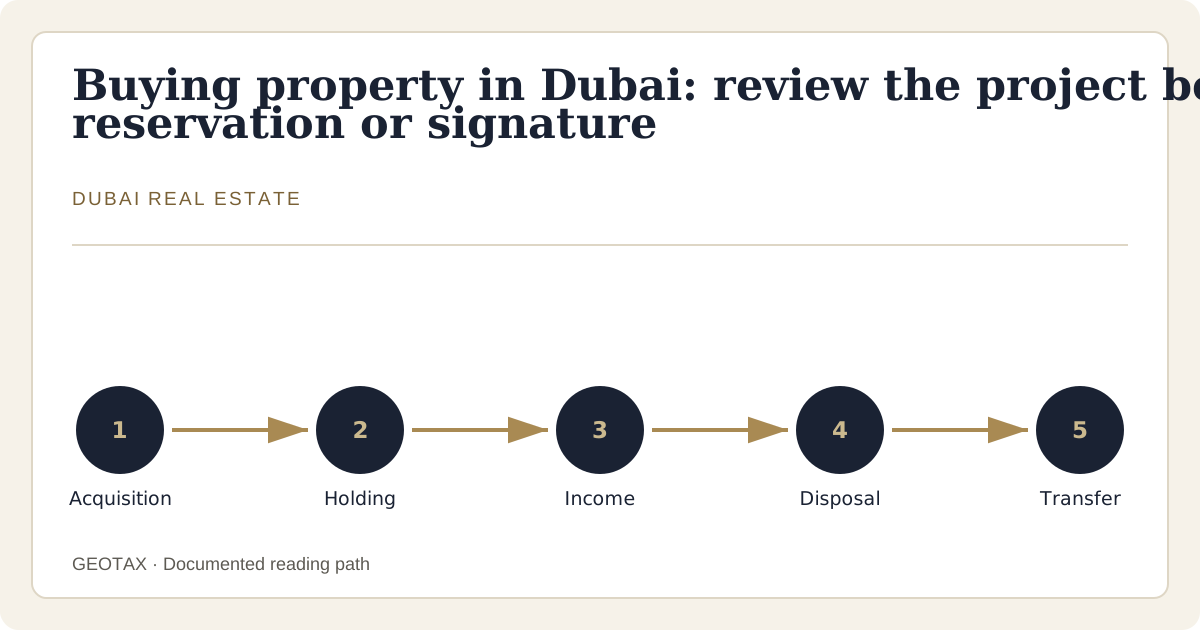
A Dubai acquisition unfolds in five stages. Each carries a specific decision or obligation, and it is the order in which they are addressed that separates a secured operation from an after-the-fact correction. The Dubai-side steps are the same for every buyer, whatever their country of residence; the home-State steps are illustrated below for a French resident and vary for other jurisdictions (see the residence profiles further down).
The first question is not about the property but about the buyer. Your State of tax residence commands the second layer of taxation: a French resident remains within the scope of IFI and French filing obligations; a UK resident faces UK rules on worldwide income and gains; a US person remains within the US worldwide tax net wherever they live. Next comes the ownership structure — direct, through a company, or through a French SCI for French buyers — whose consequences for wealth tax, income, capital gains and succession diverge sharply (see ownership structuring). This choice is hard to unwind after transfer: a later change amounts to a new conveyance, with its own costs. If the project includes a residence permit, the property Golden Visa threshold (AED 2m) is checked at this stage, as it can shape the financing.
For an off-plan purchase, the reservation phase concentrates the transaction-side checks: the developer's strength and track record, the existence of a regulated escrow account receiving the instalments, the consistency of the payment schedule with construction progress, registration of the reservation (Oqood) with the Dubai Land Department, and the delivery, delay and termination clauses. These checks call for a file review independent from the agent and the developer, described on the securing the purchase page. It is also at this stage that the identity of the purchaser on the contract — and therefore the ownership structure decided at step one — becomes, in practice, fixed.
The transfer of title crystallises the acquisition costs: the Dubai Land Department registration fee of 4% of the price — legally split equally between seller and buyer (2% each), but in practice contractually borne by the buyer alone —, trustee office fees of around AED 4,000 plus VAT for a property above AED 500,000, and a customary agency commission of around 2%. Where the purchase is financed, the mortgage is registered with the DLD; for a buyer targeting the Golden Visa, a mortgaged property requires in practice a bank letter evidencing at least AED 2m paid (see the Golden Visa page). The financing structure should be settled before transfer: it conditions the visa timetable and, in several home States, the deductibility of debt for wealth or estate tax purposes.
Dubai itself imposes no recurring tax on an individual owner: the Emirates levy no personal income tax, and the Dubai housing fee (5% of the annual rent) is borne by the tenant. The annual obligations therefore sit in the owner's State of residence. For a French resident, they are threefold: the rent is declared in France as property income (form 2047, then the income-tax return), with a treaty credit whose effect is limited to the effective rate (see rental income and the France-UAE treaty); UAE bank accounts are reported on form 3916 — accounts which are in any event visible to the French administration through automatic exchange of information (CRS); and the property enters the IFI base where worldwide net taxable real-estate wealth exceeds €1.3m. Residents of other States face their own reporting and taxation rules — see the profiles below.
The Emirates do not tax an individual's capital gain. The reckoning therefore takes place in the State of residence. For a French resident, the gain falls within the French regime for private real-estate capital gains: 19% income tax (CGI, art. 200 B) plus 17.2% social levies — real estate remaining outside the social-levy increase enacted in the LFSS 2026 — after holding-period allowances (CGI, art. 150 VC: income-tax exemption beyond 22 years of ownership, social levies beyond 30 years), with a 2% to 6% surtax on taxable gains above €50,000 (CGI, art. 1609 nonies G) and a filing on form 2048-IMM within one month of the sale (CGI, art. 150 VG). The treaty changes nothing in practice: the credit is capped at the UAE tax paid, nil for individuals, so French taxation remains effective (treaty of 19 July 1989, art. 11 §1 and 19 §1) — see resale capital gains. UK residents and US persons face their own disposal rules, outlined below.
The Golden Visa threshold — AED 2m, roughly €476,000 at July 2026 exchange rates — is a common reference point for buyers. The table below sets out the Dubai-side costs, which apply to every buyer, and illustrates the home-State layer for a French tax resident. It is not an individual simulation: the second layer depends entirely on your State of residence and overall situation.
| Phase | Item | Amount or treatment (AED 2m property) |
|---|---|---|
| Entry | DLD registration fee (4%) | AED 80,000 |
| Trustee office fee (property > AED 500,000) | ~AED 4,000 plus VAT | |
| Customary agency commission (~2%) | ~AED 40,000 | |
| Annual ownership | UAE tax on rent | None — the Emirates levy no personal income tax; the Dubai housing fee (5% of annual rent) is borne by the tenant |
| UAE Corporate Tax | Not applicable to an individual's real-estate investment income (Cabinet Decision 49/2023); the 9% Corporate Tax concerns business taxable income above AED 375,000 (Cabinet Decision 116/2022) | |
| Home-State layer (example: French resident) | Rent declared in France (form 2047; treaty credit, effect limited to the effective rate); form 3916 for UAE accounts; IFI where worldwide net real-estate wealth exceeds €1.3m — the property alone (≈ €476,000) does not cross the threshold | |
| Exit | UAE tax on the capital gain | None for an individual |
| Home-State layer (example: French resident) | 19% plus 17.2% social levies after holding-period allowances (income-tax exemption at 22 years, social levies at 30 years); 2%–6% surtax above €50,000 of gain; form 2048-IMM within one month — treaty credit nil, French taxation effective |
Two lessons. First, the Dubai-side entry cost — in the order of 6% to 7% of the price — is certain and immediate, and should be provisioned from the offer. Second, for most buyers the heaviest tax burden is not local but domestic, and it materialises on resale: holding period, ownership structure and the residence timetable determine its real amount.
Dubai treats every individual owner alike: 4% DLD fee on entry, no personal income tax on rent, no capital gains tax on resale, no inheritance tax. What differs — often dramatically — is the layer added by your State of residence. Three profiles concentrate most situations handled by the firm.
The most documented case on this site: worldwide IFI above €1.3m of net real-estate wealth (save the temporary five-year rule for new residents, CGI, art. 964, 1°, para. 2), French declaration of the rent with a credit limited to the effective rate, effective French taxation of the resale gain, and a succession article in the 1989 treaty under which immovable property is taxable in its State of situation (art. 17 §1) while company shares are in principle movable property (art. 17 §3). Each subject has its dedicated page in the silo, from rental income to capital gains and structuring.
A UK tax resident is, as a rule, within the scope of UK capital gains tax on disposals of assets worldwide — a Dubai property included — and rental income from the property is reportable in the UK, subject to the applicable reliefs. Two points deserve particular care before any move: the temporary non-residence rules, which can bring gains realised during a short period abroad back into charge on return to the UK, and inheritance tax, whose reach over non-UK assets depends on the owner's status under the rules in force. These regimes have their own thresholds and conditions, which we deliberately do not summarise in figures here: they are addressed, with the France-UAE angle set aside, on the page UK residents moving to the UAE.
A US citizen or green-card holder remains taxable in the United States on worldwide income wherever they live: rent from a Dubai property and the gain on its sale are reportable in the US, and the usual information-reporting obligations attach to foreign accounts opened for the operation. Moving to the UAE does not change this: there is no US-style exit from citizenship-based taxation short of expatriation procedures with their own consequences. The specifics are covered on the page US persons moving to the UAE.
For residents of other States, the method is constant even where the rules differ: the State of residence determines the taxation of the rent, the gain and, often, the estate; a double-tax treaty between that State and the Emirates, where one exists, allocates the taxing rights; and the civil devolution of the Dubai asset is anticipated separately — non-Muslim owners commonly use a registered will, such as a DIFC Will, to govern the succession of their Dubai property. Belgian and Swiss residents, frequent among the firm's clients, are addressed in the French version of this page. In every case, the analysis is jurisdiction-specific: a dedicated consultation is the appropriate format.
The firm receives your request by email, checks whether it calls for a GEOTAX tax review and replies by email with the appropriate format. Do not send tax documents or sensitive contracts at this stage.
Main references checked on 29 August 2026. Any application to a specific situation requires an individualised analysis.