Reporting the impatriate regime: 2042 C, 2047, 2074-IMP
The regime applies as of right — but it takes form in the tax return: elections to formalize, boxes 1AJ and 1DY/1EY, foreign income on form 2047, capital gains on form 2074-IMP, foreign accounts on form 3916. The step-by-step, and what happens if you forget.
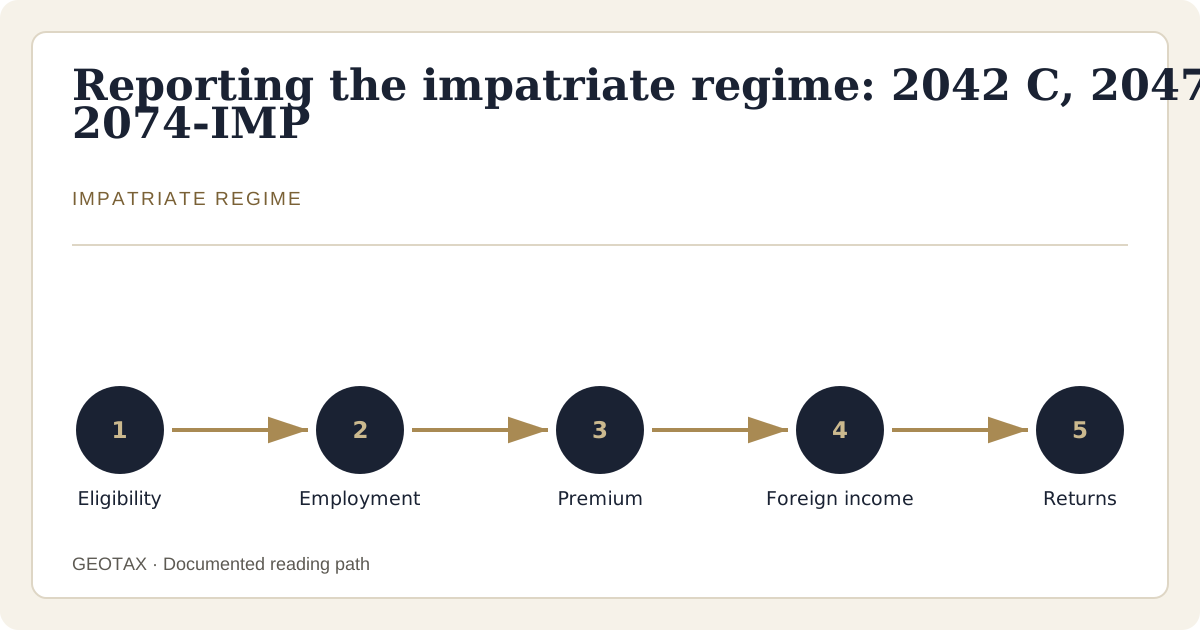
Step 1 — Exercising the elections: the express statement
The article 155 B regime applies as of right, without approval (BOI-RSA-GEO-40-10-20, § 380). Two decisions must, however, be formalized each year by the taxpayer, by an express statement in the « other information » section of the online return, or on plain paper attached to return no. 2042 (§ 390-400):
- the election for the flat-rate valuation of the impatriation bonus (30% of net remuneration);
- the choice of the capping mechanism: 50% overall or 20% on the portion of remuneration relating to the activity performed abroad.
The express statement has a second benefit: in the event of a later reassessment on the point disclosed, it excludes late-payment interest under the conditions of article 1727, II-1 of the CGI, provided the taxpayer's position was clearly set out.
Step 2 — Salaries: 1AJ/1BJ and 1DY/1EY
- Check the pre-filled amount: the tax authority carries over the employer's DSN data; in the event of an error or a different election, correct it (BOI-RSA-GEO-40-10-20, § 410).
- Box 1AJ (or 1BJ) of the 2042: the net taxable salary after deducting the exempt portion (impatriation bonus and « foreign » fraction, within the caps).
- Boxes 1DY (or 1EY) of the 2042 C: the exempt salaries and bonuses. They are not taxed, but are taken into account in computing the reference tax income (DGFiP fact sheet « Le régime des impatriés »; CGI, art. 1417, IV).
Omitting box 1DY does not reduce your tax — but it distorts the reference tax income, on which various thresholds depend (CSG rate, instalment waivers, benefits). Conversely, reporting the exempt bonus in 1AJ instead of 1DY means paying tax on exempt income: it is the most expensive mistake, common in the first year when the pre-filled return reflects a badly configured DSN.
Step 3 — Foreign investment income: form 2047 then 2042/2042 C
Income received abroad is reported first on return no. 2047, then carried over to the 2042 and the 2042 C (BOI-RSA-GEO-40-10-30-20). For income eligible for the 50% exemption, the official pattern (BOFiP example, § 310) is as follows:
- on the 2047: the taxable amount (50% of the income, including the treaty tax credit), the amount exempt up to 50%, and the treaty tax credit for its full amount;
- carry-over of the taxable amount to the 2042 (line 2DC for dividends);
- carry-over of the exempt fraction to line 2DM of the 2042 C — it serves as the additional base for social levies, which are due on the full amount;
- carry-over of the foreign tax credit to line 8VL of the 2042 C (reflected at 50% on the income tax side through the taxable amount, but creditable in full within the limit of the French tax);
- where applicable, deductible expenses (custody fees) for their full amount (line 2CA), if the progressive scale is elected.
The income-tax exemption under Article 155 B does not halve the social-levy base for the relevant investment income. The rate depends on the product and period: 18.6% for the affected 2026 categories, while 17.2% continues to apply to certain life-insurance and capitalisation products. Check the contract category and DGFiP exceptions; the impatriate regime does not impose one uniform social-levy rate on all investment income.
Step 4 — Securities capital gains: form 2074-IMP
Disposals benefiting from the 50% exemption are reported on the specific return no. 2074-IMP (capital gains and losses on disposals of securities by impatriates), which details: gains or losses realized, the amount of the exemption, the net amount after exemption, the offsetting of losses (themselves taken into account at 50%), any allowances and losses carried forward over ten years. The results are then carried over to the 2042 and 2042 C (BOI-RSA-GEO-40-10-30-30, § 70-90). Other (non-eligible) disposals are still reported on the standard 2074.
Step 5 — Foreign accounts and policies: forms 3916 / 3916 bis
A French resident must report, together with the income tax return, the references of accounts opened, held, used or closed abroad (CGI, art. 1649 A — form 3916 / 3916 bis), as well as capitalization contracts and life insurance policies subscribed outside France (art. 1649 AA). The fine is €1,500 per undeclared account or policy (CGI, art. 1736, IV), and the omission opens extended reassessment periods. For an executive returning from Dubai with local bank accounts, securities accounts and savings plans, this component is inseparable from the impatriate regime — the 50% exemption presupposes assets abroad, which the tax authority expects to see reported.
The first return after the move back
The year of return is a transition year: the person is taxable in France from the establishment of their tax domicile, under the rules for taxpayers arriving during the year. In practice, in the spring following the year of return:
- report the income received since arrival (and, for the earlier period, only French-source income where applicable);
- formalize the regime's elections (express statement) from this first return — it is also the time for the irrevocable choice between 155 B and 81 A for employees sent on assignments abroad;
- attach 2047, 2042 C (1DY/2DM/8VL), 2074-IMP and 3916/3916 bis as applicable;
- notify the tax office of your arrival (or via the online account) for attachment to the competent tax office (SIP).
There is no « blank year » strictly speaking: the period spent abroad escapes French tax not by tolerance but because the person was not a resident — the exact boundary of the switch (arrival date, home, main place of stay) must be documented. On this point, see the returning from Dubai page.
If you forget: a claim is possible, the elections are trickier
Over-taxation resulting from an oversight (bonus reported in 1AJ, passive income reported in full) can in principle be corrected through a contentious claim within the time limit of article R* 196-1 of the LPF — as a general rule until 31 December of the second year following the collection notice. As the regime applies as of right, the exemption itself is not conditional on a prior request.
The position is less certain for the elections (30% flat rate, choice of cap), which the texts attach to the return: their retroactive exercise through a claim is debated and should not be taken for granted. The course of action: prepare the first return carefully, and have the following ones reviewed whenever the composition of remuneration changes.
Supporting documents to keep (whole duration of the regime + reassessment period)
- Employment contract or addendum predating the start of duties, with the bonus clause;
- proof of recruitment from abroad (application, correspondence, residence);
- the employer's reference remuneration certificate;
- supporting documents for workdays abroad (assignment orders, boarding passes, hotel bills);
- statements of foreign accounts and portfolios, trade confirmations for disposals, evidence of foreign withholding taxes;
- proof of non-residence for the five years preceding the start of duties (foreign tax assessments, TRC, leases, etc.).
Have your first impatriate tax return reviewed
Elections, boxes, 2047, 2074-IMP and 3916: one hour by video to secure the return that conditions eight years of the regime. Fee: AED 2,000 (approx. €470).
Book a consultationOfficial sources
References current as of 11 June 2026. Applying them to any specific situation requires individualized analysis.
Statutes
- Article 155 B du CGI (Légifrance, in French); articles 1649 A and 1649 AA of the CGI (foreign accounts and policies); article 1736, IV of the CGI (fine); article R* 196-1 of the LPF (claim deadline).
Administrative guidance and forms
- BOI-RSA-GEO-40-10-20 (§ 380-410: elections and statement of exempt income — in French).
- BOI-RSA-GEO-40-10-30 and sub-sections (reporting obligations for passive income: 2047, 2042 C lines 2DM and 8VL; capital gains: 2074-IMP — in French).
- impots.gouv.fr — Le régime des impatriés (boxes 1AJ/1BJ and 1DY/1EY, the employee's formalities, updated 8 April 2026 — in French).
- BOI-RSA-GEO-40-10-40 (social levies on the unreduced base, reference tax income — in French).
Key answer
The income-tax exemption under Article 155 B does not halve the social-levy base for the relevant investment income. The rate depends on the product and period: 18.6% for the affected 2026 categories, while 17.2% continues to apply to certain life-insurance and capitalisation products. Check the contract category and DGFiP exceptions; the impatriate regime does not impose one uniform social-levy rate on all investment income.
The impatriate HR note: turnkey PDF (FR/EN)
A bilingual ~20-page note to hand to your employer: the regime, a model clause, payroll/DSN, a filing checklist, an English HR FAQ. Note only €1,500 · Note + video pack €2,000.
Get the HR note →Tax sources and review date
Fiscal review: 5 September 2026. The applicable text and tax period must be checked for each situation.