Buying Dubai property as a UK resident: tax and structuring
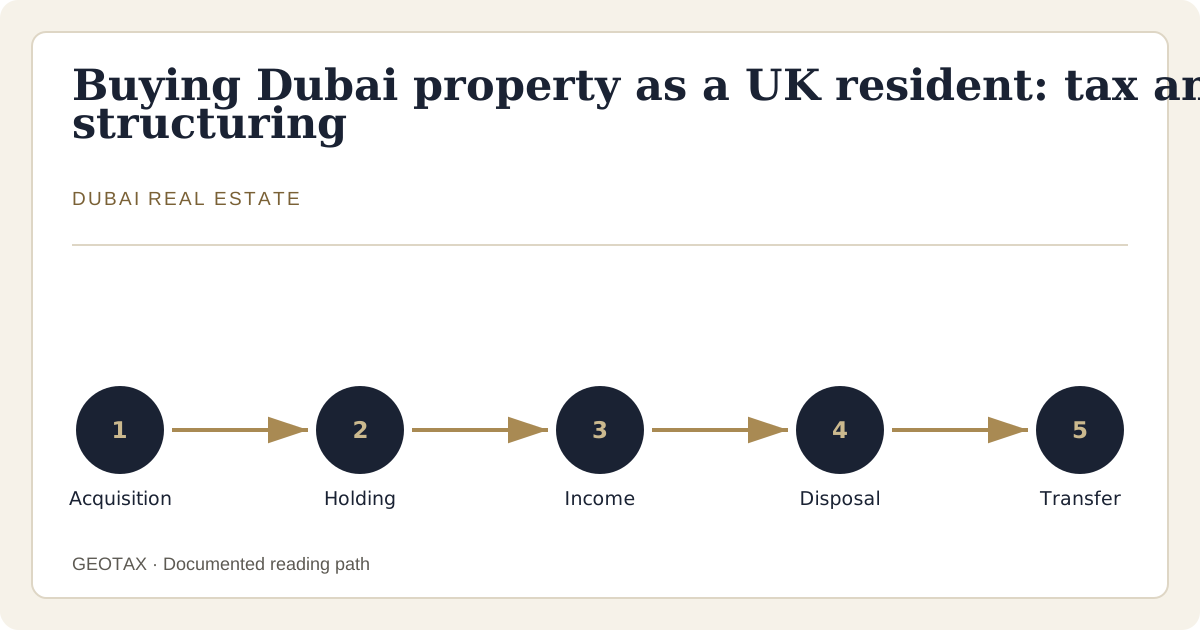
Dubai taxes neither the rent nor the resale gain; the United Kingdom taxes both, and — since 6 April 2025 — reaches worldwide estates through long-term residence rather than domicile. This page maps the UK questions a buyer should put to their advisers, alongside the Dubai-side checks.
The UAE levies no personal income tax and no capital gains tax on individuals: rent and resale gains are untaxed locally, the main entry cost being the 4% Dubai Land Department transfer fee. For a UK tax resident, however, the property remains fully within the UK net: the rent is taxable as the profits of an overseas property business, a resale gain attracts CGT at 18% or 24%, and a long-term UK resident's worldwide estate — Dubai property included — sits within inheritance tax. The 2016 UK-UAE treaty does not displace any of this: it permits both States to tax and relieves double taxation by credit — a credit that is nil in practice, since the UAE levies nothing on the individual. GEOTAX advises on the UAE and French sides; the UK analysis belongs to UK counsel.
What Dubai does — and does not — tax
The Dubai side of the equation is straightforward and does not depend on the buyer's nationality. The UAE levies no personal income tax on individuals: rent received from a Dubai apartment bears no local tax, and the gain on resale bears none either. The recurring costs are contractual and administrative — service charges, community fees — not fiscal. The main tax-like cost sits at the point of entry: the Dubai Land Department transfer fee of 4% of the price, payable on registration of the transfer.
The legal framework, on the other hand, deserves as much attention from a UK buyer as from any other. Foreign buyers acquire freehold title in the designated areas opened to non-UAE nationals (Dubai Law No. 7 of 2006); off-plan purchase monies must transit through the project's escrow account (Law No. 8 of 2007); and an off-plan sale must be recorded on the interim Oqood register (Law No. 13 of 2008), failing which it is void. These verifications are set out in detail on our page securing a Dubai property purchase.
One collateral point of interest: a property investment of at least AED 2,000,000 — approximately €476,000 (July 2026) — can open eligibility for the property Golden Visa. The DLD currently states ten years and the ICP five years, so the duration and filing route must be confirmed. A residence visa is an immigration status, not a tax residence: for a UK resident it changes nothing in the UK analysis below unless and until UK residence is actually lost under the statutory residence test.
The UK starting point: worldwide income and gains
A person who is UK tax resident is, as a rule, taxable in the UK on their worldwide income and gains. Since 6 April 2025, this applies on the arising basis to all UK residents: the remittance basis — under which foreign income and gains of non-domiciled residents escaped UK tax as long as they were kept offshore — has been abolished and replaced by the residence-based regime described below. Keeping the rent in a Dubai or offshore account therefore no longer shelters it: the income is taxable when it arises, wherever it is paid.
Everything on this page flows from that starting point. The Dubai property is locally untaxed; the UK resident who owns it is not.
Rent: an overseas property business, taxed in the UK
Rent from a Dubai property received by a UK resident individual falls within UK income tax as the profits of an overseas property business. The profit — receipts less allowable expenses — is taxed at the owner's marginal income tax rates, exactly as UK rental profits would be, and is reported on the foreign pages (SA106) of the Self Assessment return.
Where foreign tax has been paid on foreign rent, the UK ordinarily gives credit for it. Here lies the practical particularity of Dubai: since the UAE levies no personal tax on the rent, there is no foreign tax to credit, and the UK charge applies in full. The Dubai "tax-free" rent is, for a UK resident, simply UK-taxable rent — the local exemption changes the location of the tax, not its existence.
Two practical consequences follow. First, the computation must be run in sterling, with exchange rates documented. Second, the owner should keep the same records they would keep for a UK letting — tenancy contracts (Ejari registration in Dubai), invoices for charges and repairs, statements of the collecting account — both for the UK return and for any later disposal.
Selling: UK capital gains tax at 18% or 24%
On a disposal of the Dubai property, a UK resident individual realises a chargeable gain for UK capital gains tax. Under the rates published by HMRC for gains made from 6 April 2026, the gain is taxed at 18% to the extent it falls within the basic rate band and 24% above it — the same two rates that have applied to residential property disposals since the higher residential rate was reduced from 28% to 24% on 6 April 2024. The annual exempt amount (£3,000 for 2026-27) is deducted first.
The computation is made in sterling: acquisition cost and disposal proceeds are each translated at the relevant dates, so that a movement in the pound against the dirham can create — or erase — a taxable gain independently of the property market. And as with the rent, the absence of any UAE tax on the gain means the treaty credit is empty: the UK tax is borne in full, and the disposal is reported through Self Assessment.
The 2016 UK-UAE treaty: shared taxing rights, relief by credit
The United Kingdom and the UAE are bound by a Double Taxation Convention signed in 2016, in force since 25 December 2016. Its architecture on real estate is classical:
- Article 6 — income from immovable property situated in a Contracting State may be taxed in that State: the UAE, as situs State, holds the primary right to tax the rent;
- Article 13 — gains from the alienation of immovable property situated in the other State may be taxed in that other State: same allocation for the resale gain;
- Article 21 — the UK eliminates double taxation by credit: UAE tax payable is credited against the UK tax computed on the same income or gains.
The point to grasp is that "may be taxed" in the situs State does not mean "may only be taxed" there: the UK retains its right to tax its residents, subject to giving credit. Since the UAE exercises its primary right at a rate of zero for individuals, the credit mechanism runs on empty, and the treaty leaves the UK charge intact. A UK buyer should therefore never rely on the existence of a treaty as such: what matters is what the treaty actually does — here, essentially nothing for an individual's Dubai rent and gains.
Secure the Dubai side before you sign
Escrow, Oqood, title, structuring, Golden Visa: an independent review of the transaction, coordinated with your UK advisers.
Email my situation to the firmNew arrivals: the 4-year foreign income and gains (FIG) regime
The abolition of the remittance basis came with a narrower, time-limited replacement. Since 6 April 2025, a qualifying new resident — a person in their first 4 years of UK residence after at least 10 consecutive tax years of non-UK residence — may claim the foreign income and gains (FIG) regime and pay no UK tax on eligible foreign income and gains for those years. The profits of an overseas property business are expressly among the eligible categories: for a recent arrival to the UK who owns a Dubai apartment, the rent can be sheltered for up to 4 tax years.
The claim is made on the Self Assessment return, year by year and source by source, and it has a price: the claimant loses the income tax personal allowance and the CGT annual exempt amount for the year. The window is short, non-renewable, and cannot be rolled over — years of temporary absence within the 4-year period are simply lost. Whether a claim is worthwhile is a UK computation to run with UK counsel; the point here is that the regime exists and that a Dubai property fits within it.
Leaving the UK: the temporary non-residence trap
Symmetrically, a UK resident who moves to Dubai should not assume that non-residence immediately clears the way to a tax-free disposal. Under the temporary non-residence rules (section 10A TCGA 1992; HMRC helpsheet HS278), where a person who had sole UK residence in at least 4 of the 7 tax years before departure becomes non-resident and returns within 5 years, gains realised during the absence on assets held before departure are treated as arising — and are taxed — in the year of return. Selling during a short Dubai interlude therefore defers the UK tax; it does not eliminate it.
The rules carry an important nuance for property bought after leaving: gains on assets both acquired and disposed of during the period of non-residence are generally outside their scope. A Dubai apartment bought while non-resident and sold while non-resident will ordinarily escape UK CGT even on a return within 5 years — whereas the same apartment bought before departure would not. Certain categories of income received during the absence are caught by parallel rules. The sequencing of departure, purchase, sale and return is thus a genuine planning variable — one to fix with UK counsel before the event, not after. On the mirror-image French rules for a departure from France, see our page UK residents moving to the UAE and the firm's exit-tax practice.
Inheritance tax: residence-based since 6 April 2025
The reform that abolished the remittance basis also rebuilt the scope of inheritance tax. Since 6 April 2025, domicile and deemed domicile have been replaced by a residence test: a person is a long-term UK resident if they have been UK tax resident for at least 10 of the previous 20 tax years. A long-term UK resident's non-UK assets are within the scope of IHT — a Dubai apartment as much as a London one.
The status does not end at the airport. A long-term UK resident who leaves remains within the worldwide IHT net for a "tail" of between 3 and 10 tax years, graduated by the length of prior UK residence: around 3 years for someone who was resident 10 to 13 years, lengthening by one year per additional year of residence, up to 10 years for long-standing residents. Ten consecutive years of non-residence reset the test entirely.
Two practical notes for a Dubai property. First, the UAE levies no inheritance tax: there is no foreign tax to relieve the UK charge. The standard 40% rate applies to the net chargeable estate after available exemptions, liabilities, thresholds and reliefs, rather than automatically to the property's gross value. Second, on the civil-law side, non-Muslim owners of Dubai assets may register a will with the DIFC Wills Service Centre to control the local devolution of the property — an instrument of succession law which organises who inherits, but displaces none of the UK tax analysis.
What does not apply: SDLT and ATED
Some UK property taxes simply stop at the border, and it is worth saying so to avoid phantom costs in a budget. Stamp Duty Land Tax applies to acquisitions of property or land in England and Northern Ireland (Scotland and Wales have their own equivalents): it has no application to a purchase in Dubai, whatever the buyer's residence. The Annual Tax on Enveloped Dwellings applies to UK residential property held through companies: a Dubai apartment is outside it. The transfer cost that does exist is the local one — the 4% DLD fee — and the UK's interest in the purchase is limited to what follows: the taxation of the income, the gain and the estate.
Holding structures: handle with care
Buyers regularly ask whether the property should be held through a company — local or offshore — rather than in their own name. For a UK resident, interposing a company changes the nature of the analysis rather than removing it: the UK has attribution and anti-avoidance mechanisms capable of taxing a resident shareholder on income or gains accumulated in a personal holding structure, the extraction of rent as distributions creates its own layer of tax, and shares are treated differently from directly held immovable property for estate purposes. On the UAE side, a company holding the asset may bring the rent within UAE Corporate Tax, where an individual holding directly stays outside it. None of these trade-offs resembles the French ones described on our structuring page, and none should be settled by analogy: the structure must be tested under UK rules, by UK counsel, before the purchase.
Where GEOTAX fits — and where UK counsel is required
GEOTAX is a Dubai-based tax practice led by a member of the Paris Bar, focused on French-UAE taxation. On a UK buyer's Dubai purchase, the firm's role is the UAE side: securing the transaction (developer, escrow, Oqood, title), structuring the local holding, Corporate Tax analysis where a company is involved, and Golden Visa eligibility — together with the French dimension where the file has one (French assets, a French spouse, a future move to or from France).
This page is a map, not UK advice. The UK rules summarised here — arising basis, CGT rates, the FIG regime, temporary non-residence, the long-term residence IHT test — are stated as at July 2026 from HMRC and legislation.gov.uk sources cited below, and they move. Their application to a given buyer (residence years, band, reliefs, timing of departure and return) is a matter for a UK solicitor or chartered tax adviser. What GEOTAX ensures is that the Dubai structure you sign is one your UK advisers can defend.
Frequently asked questions
Official sources
References current as at 19 July 2026. UK rules evolve; their application to a specific situation requires advice from UK counsel.
- GOV.UK — Tax on foreign income — UK residents normally pay UK tax on worldwide income; arising basis for all residents from 6 April 2025.
- GOV.UK — Capital Gains Tax rates — 18% within the basic rate band, 24% above; £3,000 annual exempt amount (2026-27).
- 2016 UK-UAE Double Taxation Convention — in force 25 December 2016; articles 6 (immovable property), 13 (capital gains) and 21 (elimination of double taxation by credit).
- HMRC — 4-year foreign income and gains regime — replaced the remittance basis on 6 April 2025; overseas property business profits eligible.
- HMRC — Helpsheet HS278 — temporary non-residence (s. 10A TCGA 1992): 4-of-7-year condition, 5-year limit, charge in the year of return.
- HMRC — Inheritance Tax: long-term UK residents — 10-of-20-year test from 6 April 2025; 3-to-10-year tail after departure.
- HMRC — Self Assessment foreign pages (SA106) — reporting foreign property income.
- GOV.UK — Stamp Duty Land Tax — territorial scope: property and land in England and Northern Ireland.
- Dubai Land Department — 4% transfer fee, Oqood interim register, title deeds; escrow accounts under Law No. 8 of 2007.