The France-UAE tax treaty and Dubai property
Key answer
Signed 19 July 1989 (amended 6 December 1993), the treaty taxes real-estate income where the property is located and eliminates double taxation by a tax credit. Under the France–United Arab Emirates tax treaty of 19 July 1989 (amended by the protocol of 6 December 1993), income and gains derived from real property are taxable in the State where the property is located — Dubai for an Emirati asset. For a French resident, the elimination of double taxation is differentiated: for rental income , the tax credit equals the corresponding French tax — the rent is taken into account for the effective rate but bears no double burden; for capital gains , the credit is capped at the tax paid in the UAE — nil in practice — so French taxation remains effective. For a French resident, the elimination of double taxation differs according to the nature of the income.
Signed on 19 July 1989 (amended 6 December 1993), the treaty taxes real-estate income at the place where the property is located and eliminates double taxation on the French side through a tax credit. What this means for a French buyer in Dubai.
Under the France–United Arab Emirates tax treaty of 19 July 1989 (amended by the protocol of 6 December 1993), income and gains derived from real property are taxable in the State where the property is located — Dubai for an Emirati asset. As the UAE do not tax individuals, there is no local tax. For a French resident, the elimination of double taxation is differentiated: for rental income, the tax credit equals the corresponding French tax — the rent is taken into account for the effective rate but bears no double burden; for capital gains, the credit is capped at the tax paid in the UAE — nil in practice — so French taxation remains effective.
A treaty covering income, wealth and inheritance
The treaty between France and the United Arab Emirates was signed on 19 July 1989, published by decree no. 90-631 of 13 July 1990, and modified by a protocol of 6 December 1993 (in force from 1 June 1995). It covers income tax, wealth tax and inheritance duties (guidance BOI-INT-CVB-ARE).
The principle: taxation where the property is located
As under the OECD model, income from immovable property is taxable in the State where the property is located. Rent received in Dubai is therefore taxable in the Emirates — which levy no income tax on individuals. Symmetrically, rent from a property located in France remains taxable in France, even for a UAE resident.
Elimination of double taxation on the French side
For a French resident, the elimination of double taxation differs according to the nature of the income. For rental income, the tax credit is equal to the corresponding French tax: it bears no double burden, but remains included in total income to determine the effective rate applied to the household's other income. For capital gains, the credit is capped at the tax actually paid in the UAE (treaty, article 19, § 1) — nil in practice since the UAE levy no capital-gains tax on individuals — so French taxation remains effective.
The tax-credit mechanism and its precise effect vary according to the category of income addressed by the treaty (real-estate income, interest, capital gains). Application to a specific situation — in particular for capital gains on disposal — must be checked case by case against the treaty text and domestic law. See the capital gains page.
Tax residence: the preliminary question
The whole analysis depends on your tax residence. The treaty resolves residence conflicts through a series of tests (permanent home, centre of vital interests, habitual abode). A Golden Visa or a mere presence in Dubai is not enough to transfer residence: see UAE tax residence and Golden Visa.
Frame the treaty impact of your project
Residence, income, capital gains: how the treaty interacts with your situation, before you buy.
Email my situation to the firmThe treaty, article by article
For a property owner, the treaty is best read as a map: each article allocates a taxing right, and article 19 then organises how France eliminates double taxation. The table below summarises the provisions that matter for a Dubai asset.
| Article | Subject | Practical consequence for a Dubai property owner |
|---|---|---|
| Art. 4 | Residence and tie-breaker tests | Entry point of the whole analysis: permanent home, centre of vital interests and habitual abode determine which State treats you as resident. |
| Art. 4 A | Permanent establishment | Defines when a business has a taxable base in the other State — relevant where the property is operated through a business (para-hotel services, structured lettings). |
| Art. 5 | Income from immovable property | Rent is taxable where the property is located — Dubai for an Emirati asset, where individuals bear no income tax. |
| Art. 6 | Business profits | Profits taxable where the enterprise is established, subject to permanent establishment — matters for corporate holding or operating structures. |
| Art. 8 | Dividends | Allocates taxing rights on dividends; on the French side, the domestic regime of art. 119 bis A, II CGI applies to payments made as from 1 January 2026 (see box below). |
| Art. 11, § 1 | Capital gains | Gains on immovable property — and on shares of companies whose assets are more than 80% real estate — are taxable where the property is located. |
| Art. 16 A | Wealth | Wealth-tax provisions; they do not shield a French resident from IFI on worldwide real estate (€1.3 million threshold). |
| Art. 17, § 1 and § 3 | Inheritance | Immovable property is taxable where located; the treatment of a Dubai asset in a French-connected estate must be anticipated. |
| Art. 19, § 1 | Elimination of double taxation | Two-track credit: for rents, a credit equal to the French tax; for gains, a credit capped at the UAE tax — nil in practice. |
Credit mechanics: rents vs capital gains, worked through
Rental income: neutralised, but never invisible
- The Dubai rent is declared in France together with worldwide income;
- the French tax attributable to it is computed at the household's rates;
- a credit equal to that French tax is granted (art. 19, § 1): the rent bears no net French charge;
- but it remains in the base used to determine the effective rate — it can therefore push the household's other income into a higher average rate.
Capital gains: the credit that gives nothing back
- The resale gain is computed and declared under French rules;
- the credit is capped at the tax actually paid in the UAE — nil, since the Emirates levy no capital-gains tax on individuals;
- French taxation therefore remains effective: 19% income tax, 17.2% social levies, plus the surtax of art. 1609 nonies G CGI on gains above €50,000.
Same treaty, same article — two opposite outcomes. This asymmetry is the single most misunderstood feature of the text: see rental income and capital gains.
Article 8 of the treaty allocates taxing rights on dividends. On the French side, the domestic regime of article 119 bis A, II of the CGI applies to payments made as from 1 January 2026. For UAE-resident shareholders of French companies, the interaction between this regime and the treaty must be reviewed case by case before any distribution.
The treaty at each stage of ownership
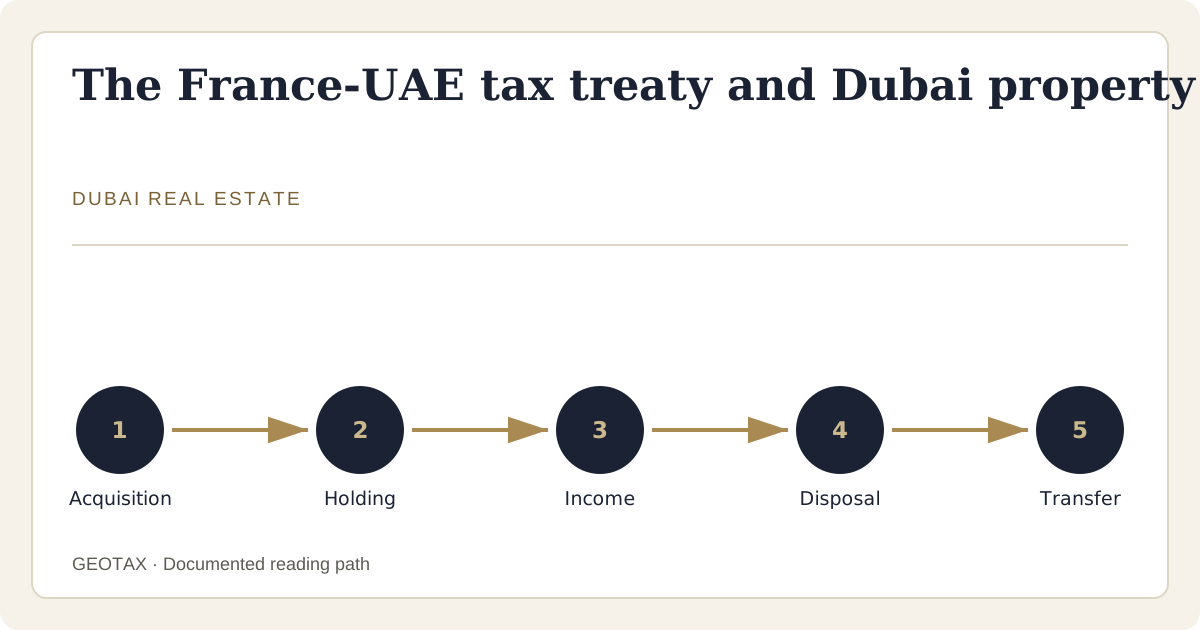
Another way to read the same map is chronological: the treaty is silent at purchase, then speaks at every later stage of the asset's life.
| Stage | Relevant provisions | What to anticipate |
|---|---|---|
| Purchase | None directly | The transaction layer is Emirati (DLD, escrow, Oqood): see securing the purchase. French reporting duties may already arise (form 3916 for a UAE bank account, in a CRS environment). |
| Holding | Art. 5 (rents), art. 16 A (wealth) | Rents declared in France with a credit equal to the French tax; the property stays in the IFI base of a French resident above €1.3 million. |
| Resale | Art. 11, § 1 and art. 19, § 1 | Credit capped at the UAE tax — nil — so effective French taxation (19% + 17.2% + 1609 nonies G surtax above €50,000). |
| Transmission | Art. 17, § 1 and § 3 | Immovable property taxable where located; the estate planning of a French-connected succession should be organised in advance. |
A French-resident instrument — not a universal shield
The France-UAE treaty allocates taxing rights between France and the UAE for their respective residents. It is decisive for a French tax resident buying in Dubai — and largely irrelevant to everyone else. A UK resident or a US person investing in Dubai must look to their own country's treaty network and domestic rules, which follow an entirely different logic: see the dedicated pages UK residents moving to the UAE and US persons moving to the UAE.
Common misreadings
- "No tax in Dubai means no tax at all." For a French resident, rents feed the effective rate and gains are effectively taxed in France.
- "The credit exempts my resale gain." It does not: the gains credit equals the UAE tax — nil.
- "The treaty settles the IFI question." Its wealth provisions do not remove a French resident's Dubai property from the IFI base.
- "A UAE certificate makes me a UAE resident for the treaty." Residence is tested on facts under article 4, not on a certificate alone.
- "Holding through a company changes the analysis." Article 11, § 1 catches shares of companies whose assets are more than 80% real estate.
Frequently asked questions
Official sources
References current as at 19 July 2026. Any application to a specific situation requires an individualised analysis.
- BOI-INT-CVB-ARE — France–United Arab Emirates treaty (signed 19 July 1989, protocol of 6 December 1993).
- Treaty text (impots.gouv.fr) — taxation of real-estate income where the property is located and elimination of double taxation.