Buying Dubai property as a Russian resident: tax and regulatory guide
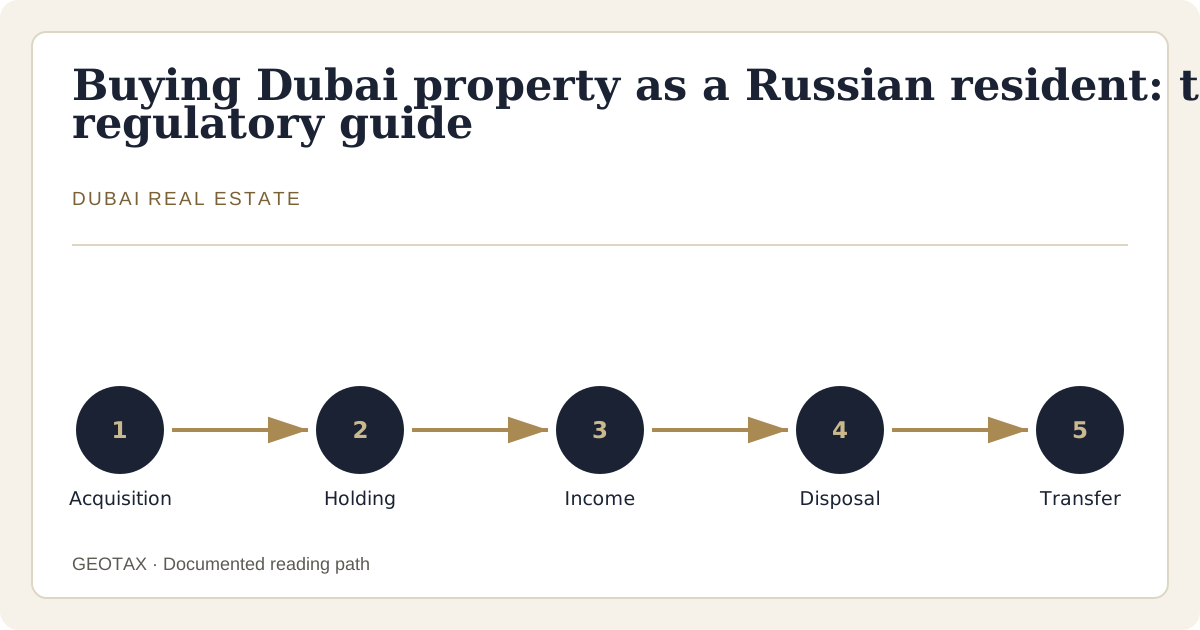
Dubai taxes neither the rent nor the resale gain; Russia taxes its residents on both, under a progressive scale rebuilt in 2025 — and surrounds the asset with currency-control notifications, CFC rules and, from 1 January 2026, a full Russia-UAE tax treaty. This page maps the Russian questions a buyer should put to their advisers, alongside the Dubai-side checks.
Rent and gains from a natural person’s private Real Estate Investment may fall outside UAE Corporate Tax. The exclusion concerns an activity that is not conducted, and is not required to be conducted, through a licence. A licensed activity, including certain holiday-home businesses, may fall within Corporate Tax when the other conditions, including the natural-person revenue threshold, are met. Failing to obtain a legally required licence does not secure exclusion. Using a licensed agent does not by itself make an owner’s private rent taxable: assess the owner’s own activity.
The UAE levies no personal income tax and no capital gains tax on individuals: rent and resale gains are untaxed locally, the main entry cost being the 4% Dubai Land Department transfer fee. For a Russian tax resident, the property remains within the Russian net: the rent falls in the main base of the progressive NDFL scale (13% to 22% since 2025), a resale gain is taxable at 13%/15% unless the minimum ownership period (as a rule 5 years) exempts it, the Dubai bank accounts must be notified and reported under currency-control rules, and a holding company triggers the CFC regime. The new Russia-UAE tax treaty, signed on 17 February 2025 and applicable from 1 January 2026, relieves double taxation by credit — a credit that is nil in practice, since the UAE taxes individuals on none of this. GEOTAX advises on the UAE and French sides; the Russian analysis belongs to Russian counsel. This statement concerns private investment excluded from Corporate Tax; a licensed business requires a separate assessment.
GEOTAX is a Dubai-based tax practice advising on UAE and French taxation. The Russian rules summarised below are a map of the questions to raise, drawn from the sources cited at the foot of the page — they are not Russian tax advice. Their application to a specific buyer is a matter for tax counsel in Russia.
What Dubai does — and does not — tax
The Dubai side of the equation does not depend on the buyer's nationality. The UAE levies no personal income tax on individuals: rent received from a Dubai apartment bears no local tax, and the gain on resale bears none either. The recurring costs are contractual and administrative — service charges, community fees — not fiscal. The main tax-like cost sits at the point of entry: the Dubai Land Department transfer fee of 4% of the price. Under the official allocation, 2% is charged to the seller and 2% to the purchaser, unless the parties agree otherwise; the contract determines who bears the economic cost. This statement concerns private investment excluded from Corporate Tax; a licensed business requires a separate assessment.
The legal framework deserves the same attention from a Russian buyer as from any other. Foreign buyers acquire freehold title in the designated areas opened to non-UAE nationals (Dubai Law No. 7 of 2006); off-plan purchase monies must transit through the project's escrow account (Law No. 8 of 2007); and an off-plan sale must be recorded on the interim Oqood register (Law No. 13 of 2008), failing which it is void. These verifications are set out in detail on our page securing a Dubai property purchase.
One collateral point: a property investment of at least AED 2,000,000 — approximately €476,000 (July 2026) — can open eligibility for the property Golden Visa. The DLD currently states ten years and the ICP five years, so the duration and filing route must be confirmed. A residence visa is an immigration status, not a tax residence: under UAE Cabinet Decision No. 85 of 2022, UAE tax residency is determined by separate criteria, and holding a Golden Visa changes nothing in the Russian analysis below for a person who remains a Russian tax resident under the 183-day test.
The Russian starting point: worldwide taxation of the resident
An individual who spends 183 days or more in Russia in a 12-month period is a Russian tax resident — for final annual residence status, presence is assessed over the relevant calendar year — and is, as a rule, taxable in Russia on their worldwide income — the income and gains from a Dubai apartment included. Since 1 January 2025, the flat-rate era is over: the main tax base is subject to a five-bracket progressive NDFL scale — 13% up to RUB 2.4 million of annual income, then 15% to RUB 5 million, 18% to RUB 20 million, 20% to RUB 50 million and 22% above — each rate applying only to the slice within its band. A separate, gentler schedule of 13%/15% (threshold RUB 2.4 million) is reserved for certain passive income, including the taxable gain on the sale of property, determined after the acquisition-cost and deduction rules available under Russian law.
An owner who ceases to be a Russian tax resident changes universe entirely: non-residents are taxed only on Russian-source income, so Dubai rent falls out of the Russian net — but so do the exemptions and the treaty protections attached to residence. This page addresses the buyer who remains a Russian tax resident.
Rent: foreign rental income in the progressive scale
Rent from a Dubai property received by a Russian tax resident is foreign-source income taxable in Russia. It belongs to the main tax base: it is aggregated with the resident's other ordinary income and taxed under the 13-22% progressive scale. No Russian withholding mechanism reaches a Dubai tenant, so the income is self-declared through the annual personal tax return, with the tax paid on assessment. The computation runs in roubles at the applicable exchange rates, which should be documented alongside the tenancy contract (Ejari registration in Dubai), charge invoices and statements of the collecting account.
The practical particularity of Dubai lies in the credit mechanism. Where foreign tax has been paid on foreign income, Russia may credit it where a treaty so provides — and from 2026 the new Russia-UAE treaty does. But since the UAE levies no personal tax on the rent, there is no foreign tax to credit and the Russian charge applies in full. The Dubai "tax-free" rent is, for a Russian resident, simply Russian-taxable rent.
Selling: the 13%/15% base and the ownership-period exemption
On a disposal, the gain realised by a Russian tax resident is in principle taxable in Russia. The taxable gain, determined after the acquisition-cost and deduction rules available under Russian law, sits in the passive base taxed at 13% up to RUB 2.4 million and 15% above. The rouble computation matters: a movement of the rouble against the dirham between purchase and sale can create — or erase — a taxable amount independently of the Dubai market.
Russian law then offers what the UK or India do not: a full exemption for real estate held for the minimum ownership period — as a rule 5 years, reduced to 3 years in specific cases (notably property received by inheritance or by gift from a close family member, or the taxpayer's only dwelling), the period now having to run uninterrupted. Russian practice generally extends this framework to foreign real estate held by residents, but the point is technical and the stakes are high: whether a given Dubai apartment qualifies — and from which date the period runs, particularly for off-plan purchases registered first on the Oqood interim register — should be confirmed with Russian counsel before the sale is signed, not after.
The new Russia-UAE treaty: in force for 2026
For years, Russia and the UAE had no comprehensive tax treaty applicable to individuals — the 2011 agreement covered only governmental institutions. That has changed: a full double tax treaty was signed on 17 February 2025, ratified by Russia in July 2025, and its provisions apply from 1 January 2026. Its real-estate architecture is classical: income from immovable property and gains from its alienation may be taxed in the State where the property is situated, and Russia relieves double taxation of its residents by credit. The treaty also brings a 10% ceiling on withholding for dividends, interest and royalties — relevant to structures, not to a directly held apartment.
The point to grasp is the same as for every buyer profile in this silo: "may be taxed" in the situs State does not mean "may only be taxed" there. The UAE exercises its primary right at a rate of zero for individuals, so the credit runs on empty and the Russian charge remains intact. What the treaty does change is the environment: resident status can now be arbitrated under treaty tie-breaker rules, and the two administrations have a framework for exchanging information. A Russian buyer should not expect it to reduce the tax on a Dubai apartment by a single rouble.
Secure the Dubai side before you sign
Escrow, Oqood, title, structuring, Golden Visa: an independent review of the transaction, coordinated with your Russian advisers.
Email my situation to the firmCurrency control: the accounts around the property
The property itself is not a currency-control asset, but everything around it is. Currency residency is distinct from tax residency: under Federal Law No. 173-FZ, Russian citizens (and foreign holders of Russian residence permits) are currency residents whatever their tax-residence position. A currency resident must notify the tax authorities of the opening, closing or change of details of accounts held with foreign banks and other financial institutions — the Dubai account opened to pay the developer or collect the rent included — and must, as a rule, file annual cash-flow reports on those accounts. Two exemptions matter here: an individual who spends more than 183 days in the year outside Russia is relieved of the notification and reporting obligations for that year; and the annual report is waived where the account is held in an EAEU State or in a jurisdiction exchanging financial information automatically with Russia — the UAE currently appear on the Russian list of such jurisdictions — and the credits/debits or year-end balance for the year do not exceed RUB 600,000 (or its foreign-currency equivalent). Permitted operations on foreign accounts are themselves a regulated list.
Separately, sanctions and counter-sanctions measures affect banking and settlement channels between Russia and the UAE; the practical routing of purchase funds is a case-by-case matter for the banks and counsel involved, and nothing on this page substitutes for that review.
Holding through a company: the CFC regime
Buyers regularly ask whether the apartment should be held through a foreign company. For a Russian tax resident, the answer passes through the controlled foreign company (CFC) rules: a foreign company (or structure without legal personality) controlled by a Russian resident must be notified to the tax authorities — both the participation and the CFC itself — and its profit may be taxed in Russia at the level of the controlling person where it exceeds the annual threshold of RUB 10 million. Rent accumulating in a Dubai holding company is precisely the kind of passive profit the regime targets. On the UAE side, a company holding the asset may bring the rent within UAE Corporate Tax, where an individual holding directly stays outside it. None of these trade-offs matches the French ones described on our structuring page: the structure must be tested under Russian law, by Russian counsel, before the purchase.
Succession: no Russian inheritance tax, a DIFC will in Dubai
On death, the Russian layer is lighter than most: Russia abolished inheritance tax with effect from 1 January 2006, and property received by inheritance is exempt from personal income tax whether the succession is by law or by will. Gifts follow a different rule: real estate received as a gift is taxable income for the recipient unless the donor is a close family member (spouse, parent, child, grandparent, grandchild, sibling). A resident heir who later sells the inherited Dubai apartment benefits from the reduced 3-year ownership period mentioned above.
On the Dubai side, the UAE levies no inheritance tax either, and the question is civil, not fiscal: absent planning, local devolution of a Dubai asset can fall under UAE law. Non-Muslim owners may register a will with the DIFC Wills Service Centre to control who inherits the property — an instrument of succession law which displaces none of the Russian analysis.
Where GEOTAX fits — and where Russian counsel is required
GEOTAX is a Dubai-based tax practice led by a member of the Paris Bar, focused on French-UAE taxation. On a Russian buyer's Dubai purchase, the firm's role is the UAE side: securing the transaction (developer, escrow, Oqood, title), structuring the local holding, Corporate Tax analysis where a company is involved, and Golden Visa eligibility — together with the French dimension where the file has one.
This page is a map, not Russian advice. The Russian rules summarised here — the 2025 progressive scale, the ownership-period exemption, the 2025 treaty, currency control and the CFC regime — are stated as at July 2026 from the sources cited below, and they move quickly. Their application to a given buyer (residence days, bases, ownership periods, banking channels) is a matter for tax counsel in Russia. What GEOTAX ensures is that the Dubai structure you sign is one your Russian advisers can defend.
Frequently asked questions
Official sources
References current as at 19 July 2026. Direct consultation of nalog.gov.ru is restricted from some jurisdictions; the professional sources below are used as reliable mirrors of the Tax Code provisions. Russian rules evolve; their application to a specific situation requires advice from counsel in Russia.
- Progressive NDFL scale from 1 January 2025 — five brackets of 13/15/18/20/22% (RUB 2.4m / 5m / 20m / 50m); 13/15% base for passive income including proceeds from property sales.
- Forte Tax & Law — Russian tax changes from 2025 — new rates and bases for individuals; worldwide taxation of residents.
- Minimum ownership period (art. 217.1 Tax Code) — 5-year rule (3 years in specified cases), now required to be continuous, for the PIT exemption on sales of residential property.
- President of Russia — ratification of the Russia-UAE double taxation agreement — treaty signed 17 February 2025, ratification law signed 7 July 2025.
- Russia-UAE treaty ratified — application from 1 January 2026 — scope (individuals and companies), 10% ceiling on passive-income withholding.
- Currency residency and foreign accounts (Law No. 173-FZ) — notification of opening/closing/changes of foreign accounts, annual cash-flow reports, relief below 183 days of presence.
- CFC rules for Russian tax residents — notification obligations and taxation of CFC profits above the RUB 10 million threshold.
- Abolition of Russian inheritance tax (from 1 January 2006) — inherited property exempt; gift-tax exemption limited to close relatives.
- Dubai Land Department — 4% transfer fee, Oqood interim register, title deeds; escrow accounts under Law No. 8 of 2007.
Home-country rules depend on tax residence, the investment structure and the relevant year. Local exemptions, currency-control permissions, CFC treatment and reporting must be checked against the current official rules before a transfer or acquisition.
Tax sources and review date
Fiscal review: 5 September 2026. The applicable text and tax period must be checked for each situation.