Dual residence conflict: the France-UAE tie-breaker rule
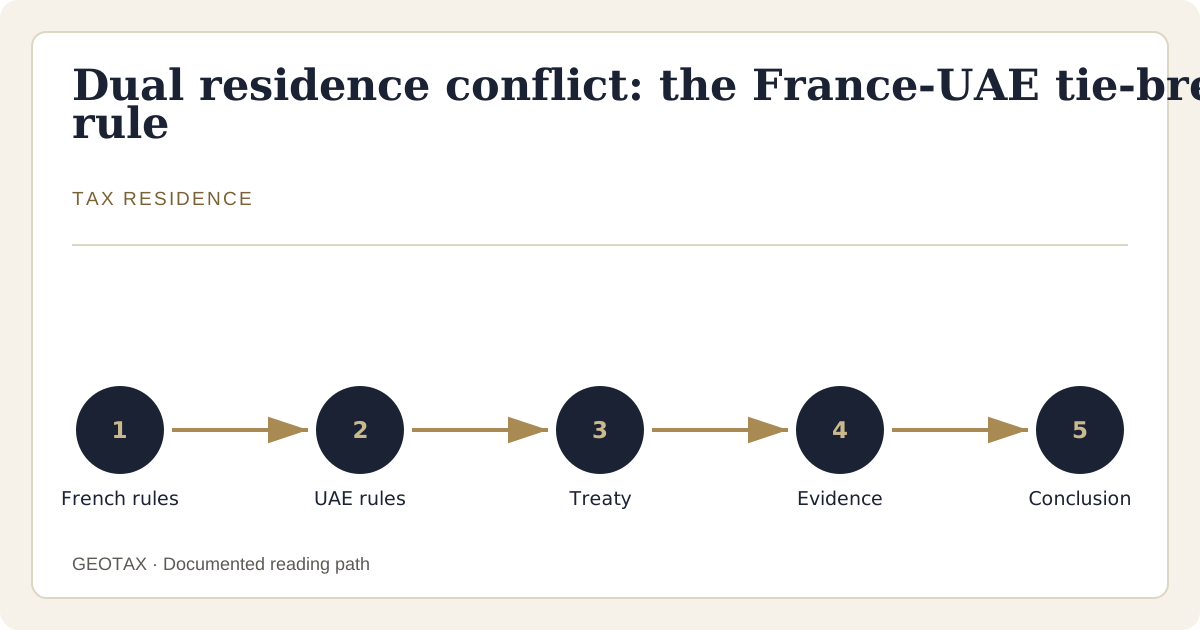
When France and the UAE both consider the same taxpayer as their resident, the bilateral treaty of 19 July 1989 resolves the conflict through a four-tier sequential framework. This page breaks down the mechanics and the pitfalls.
The origin of the conflict
French domestic law applies broad criteria (article 4 B CGI): home or principal place of abode, non-ancillary professional activity, center of economic interests. UAE domestic law (Cabinet Decision 85/2022) likewise relies on broad criteria (183 days, 90 days plus ties, home plus interests). For taxpayers with mixed profiles — assets split across jurisdictions, multiple activities, families straddling borders — both States frequently claim tax residence at the same time.
The bilateral treaty resolves this conflict through its tie-breaker rule, set out in article 4 § 2 of the treaty of 19 July 1989, modeled on article 4 § 2 of the OECD Model.
The four-tier framework
The analysis is sequential: the tests must be examined successively, in order, and you proceed to the next tier only if the previous one does not resolve the conflict (Conseil d'État, 29 October 2012, No. 346641).
Tier 1 — Permanent home (Art. 4(2)(a))
The place where the individual has a dwelling available on a durable basis and at all times — owned, rented or simply made available (OECD Commentary 2017, Art. 4, para. 13). If the taxpayer has such a home in only one of the two States, that State is selected. If both States offer a permanent home, you move to tier 2.
Tier 2 — Centre of vital interests (Art. 4(2)(a))
The State with which the individual has the closest personal and economic ties. The analysis is comprehensive and fact-based: family, principal professional activity, place where the income-generating activity is carried on — including where the income is paid through a company established elsewhere (Conseil d'État, 26 September 2012, No. 346556) —, place where assets are managed, social ties. There is no hierarchy between personal and economic ties. If the centre is clearly identifiable in one State, that State is selected; otherwise, tier 3.
Tier 3 — Habitual abode (Art. 4(2)(b))
The State where the individual stays habitually, assessed by reference to the frequency, duration and regularity of stays that form part of the person's settled routine of life, without the total duration having to exceed half the year (Conseil d'État, 16 July 2020, No. 436570). If the habitual abode is in only one State, that State is selected; otherwise, tier 4.
Tier 4 — Nationality (Art. 4(2)(c)), then mutual agreement (Art. 4(2)(d))
If the individual is a national of only one of the two States, that State is selected. If the individual is a national of both States or of neither, the competent authorities of the two States settle the question by mutual agreement (Treaty, Art. 21).
Since the 2025 Finance Act, article 4 B CGI explicitly provides that a taxpayer meeting the French domestic criteria may nevertheless be treated as a non-resident if a tax treaty assigns residence to the other State. This clarification codifies treaty primacy and makes it easier to defend taxpayers operating under the treaty regime.
Worked example
A French executive moved his residence to Dubai in July 2026. His wife and two children remained in France for the 2026-2027 school year. He occupies a leased apartment in Dubai (Ejari lease) and retains a primary residence in Paris. He runs a UAE company and earns the bulk of his income in the UAE.
- Tier 1 (permanent home): both States offer a permanent home. No resolution.
- Tier 2 (center of vital interests): principal professional activity and income are in the UAE, but family is in France. The French authorities could argue that family weighs more heavily; the UAE authorities could argue the opposite. Inconclusive on a first reading.
- Tier 3 (habitual abode): 220 days in the UAE, 130 days in France over 12 months. Habitual abode is in the UAE.
Conclusion: tax residence is assigned to the UAE under tier 3. The file remains contestable, however, and the taxpayer must keep his documentation airtight.
A strategy to lock the position down
- Rigorously document UAE presence to reinforce tier 3.
- Where possible, relocate the family to the UAE to reinforce tier 2.
- Obtain the Treaty version of the TRC to activate the treaty.
- Retain all supporting documents for 10 years (the French reassessment period is extended to ten years notably for undeclared foreign accounts or hidden activity — Article L. 169 of the French Tax Procedure Code).
- In the event of an audit, engage a tax attorney who commands both legal systems and the treaty.
Personalized audit with Jonathan Sémon, Esq.
A one-hour video conference to review your situation, calibrate your decisions, and secure your project. Fee: 2,000 AED (approx. USD 545).
Book an auditReferences
- France-UAE tax treaty of 19 July 1989, Article 4(2) (Decree No. 90-631 of 13 July 1990) — Légifrance
- Article 4 B of the French Tax Code (as amended by Law No. 2025-127 of 14 February 2025, Article 83) — Légifrance
- Conseil d'État, 29 October 2012, No. 346641 (successive examination of the treaty tests)
- Conseil d'État, 16 July 2020, No. 436570 (assessment of habitual abode) — Légifrance
- Conseil d'État, 26 September 2012, No. 346556 (centre of vital interests, economic ties)
- BOI-INT-DG-20-10-10 (treaty residence vs domestic tax domicile) — BOFiP
Key points
When France and the UAE both consider the same taxpayer as their resident, the bilateral treaty of 19 July 1989 resolves the conflict through a four-tier sequential framework. This page breaks down the mechanics and the pitfalls.
Page references: Légifrance · Légifrance