The evidence framework: building a defensible file
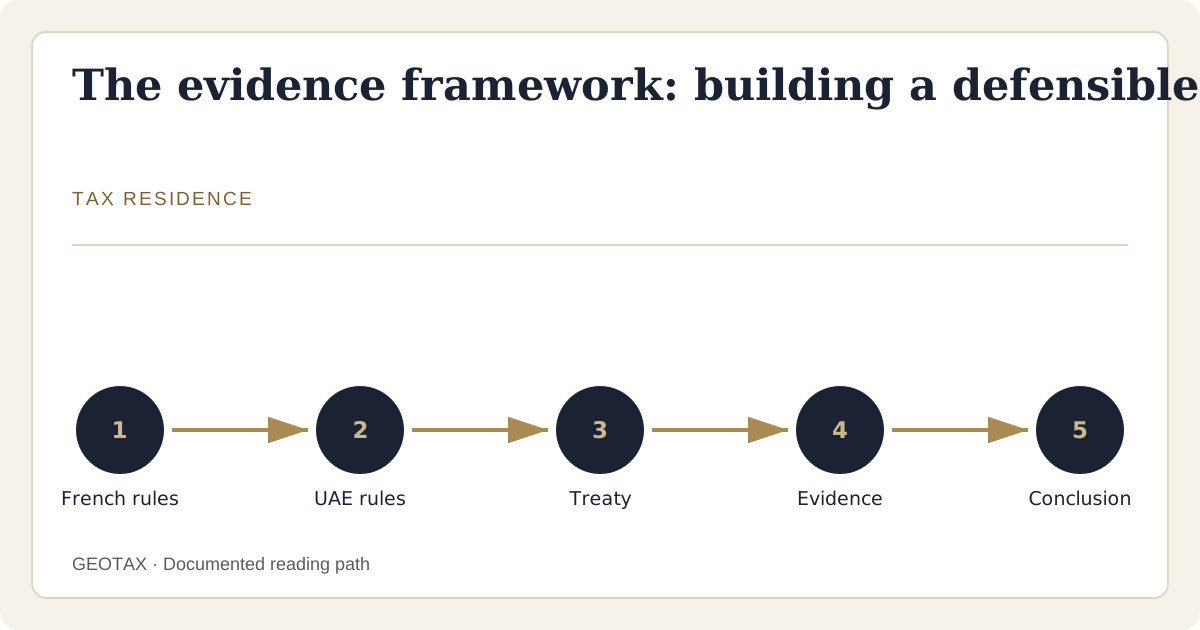
Both the French tax authority and the UAE tax authority reason by way of an evidence framework. This page lays out an operational grid of the elements to document, with sample exhibits and common errors.
Why an evidence framework?
In practice, no single element is enough to establish or contest UAE tax residence. A TRC can be challenged; physical presence of 250 days can be outweighed by a permanent home in France; UAE employment can be characterized as a sham. Both the French domestic criteria (home, principal place of stay, professional activity, centre of economic interests — Article 4 B, 1 of the French Tax Code) and the treaty criteria (permanent home, centre of vital interests, habitual abode — treaty of 19 July 1989, Article 4(2)) are assessed in light of all the factual circumstances. A robust defense rests on the coherent convergence of several categories of evidence — that is precisely what the evidence framework is.
Seven categories of evidence to document
1. Physical presence
- Passport stamps and ICA e-Gates.
- Plane tickets (purchases, boarding passes, invoices).
- Detailed presence log maintained month by month.
- ICA entry/exit report pulled from UAEPASS / ICA UAE Smart Services.
2. Housing and home
- Ejari lease (Dubai), Tasdeeq (Abu Dhabi), or title deed.
- DEWA, ADDC utility bills (depending on the emirate).
- Etisalat / du subscriptions, internet, television.
- Home insurance policies.
- Date-stamped photos of the home with personal belongings (proof of actual occupancy).
3. Family
- Resident visas of spouse and children.
- School enrollment certificates from a UAE school.
- Emirates ID cards of family members.
- Local health insurance policies covering the entire household.
4. Professional activity
- UAE employment contract, articles of association of UAE entity.
- DET or Free Zone license, commercial registry extract.
- Pay slips or income attestations.
- Bank statements showing local income flows.
- Invoices issued and received under UAE VAT (TRN).
5. Finances and assets
- Personal and corporate UAE bank accounts.
- Securities accounts, UAE brokers, portfolio statements.
- Life insurance policies underwritten locally.
- Documented real estate investments (Dubai Land Department, etc.).
6. Daily life and social ties
- Memberships in clubs, associations, gyms.
- Loyalty cards from supermarkets, pharmacies, gas stations.
- Press subscriptions, local streaming platforms.
- UAE driver's license.
7. Severing ties with France
- Closing or converting French bank accounts to non-resident status.
- Sale or rental of the French primary residence.
- De-enrollment from French social security (CFE form where applicable).
- Change of address filed with the French authorities (DGFIP, social security).
- Registration on the consular roster of French nationals residing abroad.
Maintain a structured digital file organized by category and updated monthly. Retention for 10 years (the French reassessment period is extended to ten years notably in cases of false foreign tax domiciliation or undeclared foreign accounts — Article L. 169 of the French Tax Procedure Code). Back up across multiple media (encrypted cloud, external hard drive, paper copies of the most critical exhibits).
How much weight does each category carry?
The French tax authority does not formally rank the categories, but experience shows that some weigh more heavily in practice:
- Family — the location of spouse and children weighs heavily on the French domestic foyer (Article 4 B, 1(a) of the French Tax Code) and on the treaty centre of vital interests (treaty, Art. 4(2)(a); see Conseil d'État, 26 September 2012, No. 346556).
- Permanent home — the effective availability of the dwelling at all times, more than the legal title.
- Principal professional activity — place where the income-generating activity is actually performed, not just nominal (Conseil d'État, 26 September 2012, No. 346556).
- Assets and investments — where the money is held and from where it is administered.
- Physical presence — the starting point of the analysis but rarely decisive on its own; habitual abode is assessed by the frequency, duration and regularity of stays (Conseil d'État, 16 July 2020, No. 436570).
Common errors
- Retaining a significant activity in France (active corporate office, self-employment).
- Keeping spouse and children in France with continued school enrollment.
- Keeping the main French bank account active as the reference account.
- Maintaining a fragmented evidentiary file scattered across multiple platforms.
- Renewing exhibits sporadically rather than continuously.
Personalized audit with Jonathan Sémon, Esq.
A one-hour video conference to review your situation, calibrate your decisions, and secure your project. Fee: 2,000 AED (approx. USD 545).
Book an auditReferences
- Article 4 B of the French Tax Code — Légifrance
- France-UAE tax treaty of 19 July 1989, Article 4(2) — Légifrance
- Article L. 169 of the French Tax Procedure Code (reassessment period) — Légifrance
- Conseil d'État, 26 September 2012, No. 346556 (centre of vital interests); Conseil d'État, 16 July 2020, No. 436570 (habitual abode) — Légifrance
- Cabinet Decision No. 85 of 2022 — tax.gov.ae (PDF)
Key points
Both the French tax authority and the UAE tax authority reason by way of an evidence framework. This page lays out an operational grid of the elements to document, with sample exhibits and common errors.
Page references: Légifrance · Légifrance